For 2027, the Current Procedural Terminology (CPT)® Editorial Panel approved a comprehensive restructuring of the CPT maternity care service codes from the long-standing global maternity bundle to more granular, service-level reporting.
Background
Beginning January 1, 2027, the CPT code set is replacing the established global maternity care reporting structure with more granular reporting across the antepartum care, labor management, delivery, and postpartum care continuum.1 The restructuring deletes 17 legacy maternity codes, creates 12 new codes, and revises six existing codes, replacing the traditional global package with a more granular framework that proposes to better capture when and how maternity services are delivered.2 Antepartum and postpartum practitioner visits will generally be reported using existing evaluation and management (E/M) codes, while new codes will be reported for labor management and delivery services.
This code restructuring requires health plans to reconsider how maternity care services are coded and reimbursed. Simply applying existing fee schedules to the newly unbundled services is unlikely to produce comparable economics to the historical global maternity payment.
In this paper, we’ll discuss the following:
- How could payers establish reimbursement for the newly unbundled maternity services?
- Are existing E/M fee schedule rates appropriate for prenatal and postpartum visits?
- How can payers evaluate the effect of the coding restructuring on total maternity spending and member cost sharing?
Why maternity coding is changing
The 2027 maternity coding changes followed years of advocacy by the American College of Obstetricians and Gynecologists (ACOG) and nearly two years of collaborative work with the CPT Editorial Panel and other national medical specialty societies. ACOG advocated for the CPT code changes to better align with current practice patterns, improve transparency and data quality, and ensure that payments more accurately reflect the complexity and intensity of care.3 Historically, a single global code bundled reporting of antepartum care, labor and delivery, and postpartum care, providing limited visibility into the actual number, timing, setting, intensity, and provider for each of the maternity care services delivered under the global bundle.
Historically, the global coding structure represented a relatively standardized care model in which one physician or group practice provided a predictable schedule of prenatal visits, delivery, and postpartum care. In practice, maternity care has become increasingly intense and individualized in the context of differences in patient risk, sometimes involving multiple providers and settings. Patients may:
- Receive care from multiple physicians, advanced practice practitioners (APPs), or certified nurse-midwives (CNMs)
- Transfer between practices during pregnancy
- Receive services through telehealth
- Have their care transferred from local settings to centers equipped for high-acuity care
- Require more or fewer visits based on their clinical and social needs
Unbundling the global package allows services to be reported and reimbursed as they are delivered, better reflecting these real-world practice patterns while providing more granular data to support appropriate reimbursement, quality measurement, care attribution, maternal health research, and future payment models.
Prenatal care is becoming more individualized
Historically, routine prenatal care in the United States followed a standardized schedule of approximately 12–14 visits for an uncomplicated pregnancy, generally4:
- Every 4 weeks through 28 weeks’ gestation
- Every 2 weeks from 28 to 36 weeks
- Weekly from 36 weeks until delivery
This traditional schedule was largely standardized, rather than tailored to individual risk.
The COVID-19 pandemic catalyzed changes in prenatal care delivery. In response, ACOG and the University of Michigan convened an independent expert panel to develop recommendations for tailoring prenatal care delivery.5 In May 2025, ACOG issued Clinical Consensus No. 8, Tailored Prenatal Care Delivery for Pregnant Individuals, providing guidance on prenatal care in three key areas: addressing unmet social needs, tailoring the frequency of prenatal visits and monitoring, and incorporating telemedicine and alternative care modalities.6 The guidance supports a shift away from a standardized prenatal visit schedule toward a more individualized approach based on each patient’s clinical and social needs. For low- to average-risk pregnancies, this may result in fewer routine in-person visits, while patients with greater clinical or social needs may require more frequent monitoring and care.
Three systematic reviews cited by ACOG found generally comparable maternal and neonatal outcomes and positive patient experiences with targeted schedules consisting of approximately 6–10 visits for average-risk individuals without medical or pregnancy complications.7,8,9 ACOG’s implementation guidance supports a targeted schedule of approximately eight to nine visits as an evidence-supported option for patients without chronic or pregnancy-related conditions.10,11
Importantly, a targeted schedule does not mean providing less prenatal care. Rather, the timing, frequency, and modality of care can be tailored to individual needs, incorporating longer visits, telemedicine, or home monitoring as appropriate and increasing the intensity of care if clinical or social needs emerge. This approach may reduce the burden of routine visits for low- to average-risk patients while allowing clinical resources to be directed toward patients requiring more intensive monitoring and care.
As prenatal care shifts toward more individualized visit schedules and alternative care modalities, historical utilization patterns may no longer reliably reflect the frequency or mix of services delivered during pregnancy and therefore may need to be reconsidered when establishing reimbursement.
The RUC valuation raises an important question for payers
The American Medical Association (AMA)/Specialty Society Relative Value Scale (RVS) Update Committee (referred to as the RUC) is an expert panel of physicians who make recommendations to the federal government on the resources (e.g., physician work, clinical staff time, medical supplies and medical equipment, professional liability insurance) required to provide medical services.12 The RUC makes recommendations to the Centers for Medicare and Medicaid Services (CMS), the agency that makes all decisions about fee-for-service (FFS) payment under the Medicare Physician Fee Schedule (MPFS). Medicare FFS reimburses physicians and other clinicians based on the MPFS, which assigns payment rates for about 10,000 healthcare services at the HCPCS-code level, including office visits, diagnostic procedures, and surgical procedures. Although maternity services represent a relatively small share of MPFS utilization because most Medicare beneficiaries are age 65 or older, MPFS RVUs often have broader relevance because they may serve as a benchmark for professional reimbursement in other lines of business.
CMS reviews these recommendations and ultimately determines the RVUs used for MPFS payment. Although these determinations directly affect Medicare reimbursement, the impact may extend beyond Medicare to Medicaid and commercial payers, many of which reference MPFS RVUs as a benchmark for clinician reimbursement or use related fee-schedule methodologies. Actual payment for Medicaid and commercial plans, however, depends on each payer’s applicable fee schedule and contracted rates.
The maternity global codes were last valued by the RUC in 2009 and had not been revalued before the 2027 CPT restructuring.13 The 2009 valuation used a building-block methodology, combining the assigned work RVUs associated with expected antepartum visits, labor management, delivery, and postpartum care into a single global value. Consistent with prevailing clinical practice at the time (which included 12–14 visits), the valuation assumed 13 antepartum visits. According to the AMA/RUC Summary of Recommendations, antepartum care accounted for 14.15 of the total 32.69 work RVUs assigned to the vaginal delivery global code (CPT 59400), or approximately 43% of the historical professional maternity work RVU global valuation.
At its January 2026 meeting, the RUC developed budget-neutral valuation recommendations for the new code structure and modeled a representative prenatal care pathway of 12 prenatal visits (one visit fewer than the original 2009 valuation) to estimate physician work under the transition from global maternity billing to encounter-based E/M reporting.14 However, in the CY 2027 MPFS Proposed Rule, published July 14, 2026, CMS questioned the RUC’s assumption of 12 prenatal E/M visits in the predictive year under the new code structure (2027 and beyond).15 Evolving clinical practice supports a more individualized approach to prenatal care, and the average patient sample antepartum visit schedule in the ACOG guidelines includes eight visits.16 CMS believes that using a 12-visit assumption could overstate prenatal visit utilization and, in turn, undervalue the physician work associated with the new labor and delivery codes. CMS therefore proposed revising the RUC recommendation to include eight prenatal E/M visits (consistent with the ACOG recommendation for average-risk pregnancies) instead of 12 and reallocating the associated RVUs to labor and delivery, resulting in a 15% increase in proposed work RVUs for those services compared to the RUC recommendations.
CMS is also considering creating Healthcare Common Procedure Coding System (HCPCS) G-codes to preserve the existing maternity coding and payment structure for MPFS payment rather than transitioning to the new 2027 CPT framework.17 CMS expressed concern that replacing the long-standing global maternity structure could be disruptive based on how the existing code structure is accounted for in clinical practice. They sought public comments on the potential effects of the coding change on the clinical outcomes of maternity care, as well as comments supporting or opposing the creation of new maternity HCPCS G-codes. Because the legacy CPT maternity codes will be deleted for 2027, HCPCS G-codes would provide a mechanism for the MPFS to maintain the current global approach to the maternity care code family while the impacts of the CPT coding changes are evaluated. However, if G-codes are created and remain available alongside the new CPT coding pathway, the impact of the CPT changes should be interpreted with caution, as payers will select a single coding pathway based on their preferences and payment strategies. Benchmarks should therefore consider both coding pathways when evaluating changes in maternity costs and utilization.
The central payer question: Are existing E/M rates appropriate for payment of maternity visits?
Payers should assess whether their existing E/M fee schedules appropriately reimburse individual prenatal visits. Historically, prenatal reimbursement was embedded within the maternity global payment so contracted E/M rates may not have been established with routine prenatal care in mind. Under the 2027 maternity care CPT coding restructuring, however, the combination of visit frequency, E/M level, and contracted E/M rate will directly determine prenatal visit reimbursement. Payers should therefore evaluate whether their existing fee schedules yield reasonable reimbursement for prenatal visits based on historical utilization (known or assumed) and projected utilization for their covered population relative to the historical value of prenatal care visits within the global package. This assessment will depend not only on the contracted E/M rates, but also on the frequency and mix of E/M levels providers ultimately bill for prenatal visits.
The RUC’s assumed distribution of two Level 2 established-patient visits (99212), eight Level 3 established-patient visits (99213), and two Level 4 established-patient visits (99214) as base care provides a starting point, as does CMS’s revised assumption of eight Level 3 established-patient prenatal visits), but actual frequency and coding of visit complexity may differ.18,19 Until actual claims experience becomes available, payers may want to model alternative E/M level distributions for prenatal visits to understand how different coding patterns could affect prenatal visit and overall maternity reimbursement. Payers can evaluate the potential impact by reconstructing historical maternity episodes under the new coding framework and comparing expected episode-level reimbursement with historical payments.
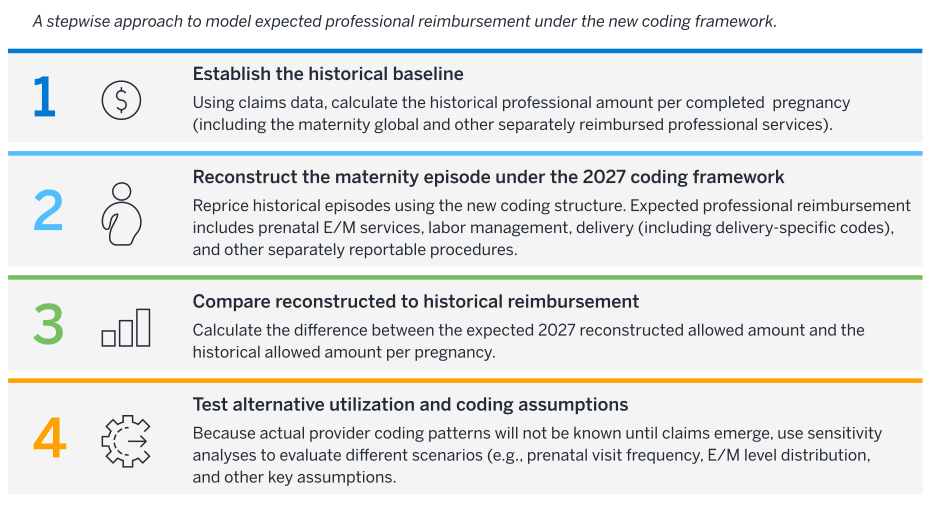
Plans may want to evaluate how results vary under different utilization and E/M visit level distribution assumptions. Sensitivity analyses could combine prenatal visit scenarios of 8, 10, and 12 encounters with lower-intensity, base care, and higher-intensity E/M visit-level distributions.
Payment neutrality does not equate to member cost-share neutrality
The transition from global maternity billing to individually reported services may change when and how member cost sharing is applied, even if aggregate provider reimbursement for maternity care remains similar.
Beginning in 2027, individual prenatal and postpartum E/M visits will be separately identifiable, creating an opportunity for payers to more precisely apply benefit and cost-sharing rules. The AMA and ACOG encourage payers to use modifier TH, Obstetrical treatment/services, prenatal or postpartum, along with pregnancy-specific diagnosis coding, to identify prenatal and postpartum services.20,21 These indicators can help payers identify maternity-related encounters but do not, by themselves, determine whether a service qualifies as preventive. Payers will need to distinguish qualifying preventive prenatal and postpartum services from nonpreventive or problem-oriented care when applying benefit and cost-sharing rules. HRSA-supported guidelines require most non-grandfathered plans to cover qualifying preventive services without copayments, coinsurance, or deductibles and recognize that prenatal and postpartum visits may be part of well-woman preventive care.22 This does not mean that every visit provided during pregnancy is automatically preventive and exempt from cost sharing.
As a result, payers should evaluate not only the provider reimbursement impact of the new maternity care codes but also how the coding changes interact with benefit design and claims adjudication. Particular attention may be needed to ensure that preventive prenatal and postpartum services are appropriately identified and paid without cost sharing, while cost sharing for nonpreventive prenatal and postnatal visits, labor and delivery, and other maternity care services is correctly identified and applied.
Payers should therefore evaluate whether existing claims processing edits adequately address the new maternity code combinations. Edits will need to distinguish code combinations that are appropriately reported together, combinations that generally should not be reported together, and unusual combinations that may be appropriate under specific clinical circumstances. For example, a labor management code may appropriately be reported with a vaginal delivery code on the same date of service, whereas reporting both straightforward and complex labor management codes by the same physician for the same date of service would not be appropriate according to CPT guidelines.23
Focus on the episode, not just the unit price
Given the magnitude of the maternity care coding changes, 2027 will provide an important opportunity for payers to establish new utilization and payment benchmarks. Milliman can support post-implementation monitoring to evaluate how provider billing and care patterns evolve under the new structure, including:
- Visit utilization: Prenatal and postpartum E/M visits per pregnancy, including the number and timing of visits throughout the maternity episode (first prenatal visit through postpartum visit)
- E/M coding intensity: Distribution of encounters across E/M levels (e.g., 99212, 99213, and 99214) and changes in coding patterns over time
- Provider payment: Total professional allowed amounts per maternity episode and changes relative to historical global maternity payments
- Member cost sharing: Total member liability across prenatal and postpartum visits, labor, and delivery
- Clinical variation: Differences in utilization, coding (including prenatal and postpartum visits), and payment by pregnancy risk, complications, and delivery type
- Provider variation: Differences in visit frequency, E/M visit coding intensity, and maternity episode professional payments across clinicians and group practices
- Access and care patterns: Changes in visit frequency, timing, telehealth use, and other patterns of care following implementation
- Claims-edit performance: Frequency of denied, corrected, or manually reviewed maternity claims; patterns of potentially duplicative or mutually exclusive services; and unusual code combinations requiring clinical or coding review
Conclusion/opportunities for future evaluation
As experience develops under the new maternity care coding structure, Milliman can use emerging claims data and episode-based analytics to establish benchmarks, identify outlier billing or utilization patterns, and assess the broader impact on maternity care. Using tools such as the Milliman Episode Grouper with Risk Adjustment (ERA), payers can compare risk-adjusted maternity episode utilization and costs across providers and populations, helping distinguish changes in coding intensity or visit frequency from changes in overall care intensity. Over time, these analyses can identify shifts in the mix and timing of services, show the relationship between patient risk and maternity care utilization and cost; assess effects on total maternity spending; and inform payment, contracting, and utilization management strategies. For more information, please reach out to your Milliman consultant.
1 American Medical Association. (2026, September 17). CPT® 2027 maternity care services code changes. Retrieved September 30, 2026, from https://www.ama-assn.org/practice-management/cpt/cpt-2027-maternity-care-services-code-changes.
3 American Medical Association. (2026). Maternity care Current Procedural Terminology (CPT)® code set updates: Modernizing to improve maternity care. Retrieved September 30, 2026, from .
4 Kilpatrick, S.J., Papile, L.-A., & Macones, G.A. (Eds.). (2017). Guidelines for perinatal care (8th ed.). American Academy of Pediatrics.
5 Peahl, A.F., Turrentine, M., Barfield, W., Blackwell, S.C., & Zahn, C.M. (July 2022). Michigan plan for appropriate tailored healthcare in pregnancy prenatal care recommendations: A practical guide for maternity care clinicians. Journal of Women’s Health, 31(7), 917–925. Retrieved September 30, 2026, from https://pmc.ncbi.nlm.nih.gov/articles/PMC11362983.
6 American College of Obstetricians and Gynecologists Committee on Clinical Consensus—Obstetrics. (2025, May 17). ACOG Clinical Consensus No. 8: Tailored prenatal care delivery for pregnant individuals. Obstetrics & Gynecology, 145(5), 565 –577. Retrieved September 30, 2026, from https://journals.lww.com/greenjournal/fulltext/10.1097/aog.0000000000005889~acog-clinical-consensus-no-8-tailored-prenatal-care-delivery.
7 Barrera, C.M., et al. (2021, October 1). A review of prenatal care delivery to inform the Michigan Plan for Appropriate Tailored Healthcare in Pregnancy panel. Obstetrics & Gynecology, 138(4), 603–615. Available from https://pubmed.ncbi.nlm.nih.gov/34352841.
8 Balk, E.M., Danilack, V.A., Bhuma, M.R., Cao, W., Adam, G.P., Konnyu, K.J., & Peahl, A.F. (2023, July 1). Reduced compared with traditional schedules for routine antenatal visits: A systematic review. Obstetrics & Gynecology, 142(1), 8–18. Available from https://pubmed.ncbi.nlm.nih.gov/37290105.
9 Dowswell, T., Carroli, G., Duley, L., Gates, S., Gülmezoglu, A.M., Khan-Neelofur, D., & Piaggio, G. (2015, July 16). Alternative versus standard packages of antenatal care for low-risk pregnancy. Cochrane Database of Systematic Reviews, 2015(7). Retrieved September 30, 2026, from https://pmc.ncbi.nlm.nih.gov/articles/PMC7061257.
10 Peahl, A.F., Turrentine, M., Barfield, W., Blackwell, S.C., & Zahn, C.M. (July 2022). Michigan plan for appropriate tailored healthcare in pregnancy prenatal care recommendations: A practical guide for maternity care clinicians. Journal of Women’s Health, 31(7), 917–925. Retrieved September 30, 2026, from https://pmc.ncbi.nlm.nih.gov/articles/PMC11362983.
11 American College of Obstetricians and Gynecologists Committee on Clinical Consensus—Obstetrics. (2025, May 17). ACOG Clinical Consensus No. 8: Tailored prenatal care delivery for pregnant individuals. Obstetrics & Gynecology, 145(5), 565 –577. Retrieved September 30, 2026, from https://journals.lww.com/greenjournal/fulltext/10.1097/aog.0000000000005889~acog-clinical-consensus-no-8-tailored-prenatal-care-delivery.
12 American Medical Association. (n.d.). An introduction to the RUC. Retrieved September 30, 2026, from https://www.ama-assn.org/system/files/introduction-to-the-ruc.pdf.
13 Centers for Medicare and Medicaid Services. (2025, January 20). Maternal health: CMS' actions to address the United States' maternity care crisis. Retrieved September 30, 2026, from https://www.cms.gov/maternal-health.
14 American Medical Association. (January 2026). AMA/Specialty Society RVS Update Committee (RUC) summary of recommendations: Maternity care services. Retrieved September 30, 2026, from https://www.ama-assn.org/system/files/ruc-maternity-care-services-recommendations.pdf.
15 Centers for Medicare and Medicaid Services. (2026, July 16). Medicare and Medicaid programs; CY 2027 payment policies under the physician fee schedule and other changes to Part B payment and coverage policies. Proposed rule. Federal Register. Published July 16, 2026. Retrieved September 30, 2026, from https://www.federalregister.gov/documents/2026/07/16/2026-14327/medicare-and-medicaid-programs-cy-2027-payment-policies-under-the-physician-fee-schedule-and-other.
16 American College of Obstetricians and Gynecologists. (n.d.). Supplemental digital content Appendix 1. Sample schedules for prenatal care services and visit frequency ACOG clinical consensus number 8: Tailored prenatal care delivery for pregnant individuals. Sample schedules for prenatal care services and visit frequency. Retrieved September 30, 2026, from https://cdn-links.lww.com/permalink/aog/e/aog_145_5_2025_03_28_jones_25-345_sdc5.pdf.
17 Centers for Medicare and Medicaid Services. (2026, July 16). Medicare and Medicaid programs; CY 2027 payment policies under the physician fee schedule and other changes to Part B payment and coverage policies. Proposed rule. Federal Register. Published July 16, 2026. Retrieved September 30, 2026, from https://www.federalregister.gov/documents/2026/07/16/2026-14327/medicare-and-medicaid-programs-cy-2027-payment-policies-under-the-physician-fee-schedule-and-other.
18 American Medical Association. (January 2026). AMA/Specialty Society RVS Update Committee (RUC) summary of recommendations: Maternity care services. Retrieved September 30, 2026, from https://www.ama-assn.org/system/files/ruc-maternity-care-services-recommendations.pdf.
19 Centers for Medicare and Medicaid Services. (2026, July 16). Medicare and Medicaid programs; CY 2027 payment policies under the physician fee schedule and other changes to Part B payment and coverage policies. Proposed rule. Federal Register. Published July 16, 2026. Retrieved September 30, 2026, from https://www.federalregister.gov/documents/2026/07/16/2026-14327/medicare-and-medicaid-programs-cy-2027-payment-policies-under-the-physician-fee-schedule-and-other.
20 American Medical Association. (2026, September 17). FAQs: CPT® 2027 coding for antepartum care (prenatal). Retrieved September 30, 2026, from https://www.ama-assn.org/practice-management/cpt/faqs-cpt-2027-coding-antepartum-care-prenatal.
21 American College of Obstetricians and Gynecologists. (n.d.). Payment for obstetric services. Retrieved September 30, 2026, from https://www.acog.org/practice-management/coding/coding-library/payment-for-obstetric-services.
22 Health Resources and Services Administration. (December 2025). Women’s preventive services guidelines. Retrieved September 30, 2026, from https://www.hrsa.gov/womens-guidelines.
23 American Medical Association. (2026). CPT Maternity Care Services Codes and Guidelines. Retrieved September 30, 2026, from https://www.ama-assn.org/system/files/cpt-maternity-care-codes-guidelines.pdf.