Background: How GLP-1s evolved from diabetes treatment to anti-obesity medications
Glucagon-like peptide-1 receptor agonists (GLP-1s) have a notable history in medical treatment, beginning as therapies for type 2 diabetes and later emerging as highly effective agents for weight loss. Initially, GLP-1 drugs were developed and approved to lower blood sugar and A1C levels in patients with type 2 diabetes. However, during clinical trials, researchers observed that these medications also led to significant weight loss in many participants, prompting further studies specifically targeting populations with obesity.1
GLP-1s work by mimicking the action of the natural GLP-1 hormone, which has several effects on the body. These include the increase of satiety (the feeling of fullness) by slowing gastric emptying and influencing the brain’s perception of hunger, leading to reduced food intake.2 Currently approved GLP-1 drugs for chronic weight management include Saxenda, which is a once-daily injection, and Wegovy and Zepbound, which are once-weekly injections. A once-daily Wegovy pill was approved in late December 2025.3
Medicaid coverage for weight-loss drugs
Medicaid is required to provide coverage for any FDA-approved drug that meets the federal definition of a covered outpatient drug and for which the manufacturer has entered into a rebate agreement with the Department of Health and Human Services Secretary (i.e., the Medicaid Drug Rebate Program [MDRP]). However, there are a limited number of drugs and drug classes for which states have flexibility to determine coverage.4 One such instance for which states have this flexibility is for “agents when used for anorexia, weight loss, or weight gain.” Hence, states that participate in MDRP are not required to cover agents for weight loss and may elect not to cover anti-obesity medications (AOMs) such as Saxenda, Wegovy, and Zepbound for their weight loss indications.
Given that obesity impacts approximately 40% of American adults, a quarter of them with severe obesity,5 state coverage decisions for weight loss agents are a topic of significant clinical and budgetary consideration. Currently, only a minority of state Medicaid programs cover GLP-1s indicated for chronic weight management, but the landscape is fluid as Medicaid decision makers attempt to strike a balance between expanding treatment options for obesity and state budget limitations.
Current AOM coverage landscape and recent changes
As of August 2024, Medicaid programs in 13 states covered at least one GLP-1 approved for weight management.6 Since then, states have altered their positions on covering anti-obesity GLP-1 therapies: Four have withdrawn coverage entirely (California, New Hampshire, Pennsylvania, and South Carolina), three have added coverage (Missouri, Tennessee, and Utah), and at least two states (Michigan and Virginia) have enacted more narrow utilization criteria, limiting future use to those with morbid obesity. Notably, North Carolina removed and subsequently reinstated coverage between August 2024 and January 2025. Figure 1 shows Medicaid GLP-1 AOM coverage by state and highlights states with recent changes. States continue to enact policy changes with significant ramifications for prospective prescription drug spending, underscoring the ongoing attention paid to this drug class by Medicaid agencies.
Figure 1: Landscape of GLP-1 coverage in Medicaid for weight loss indication
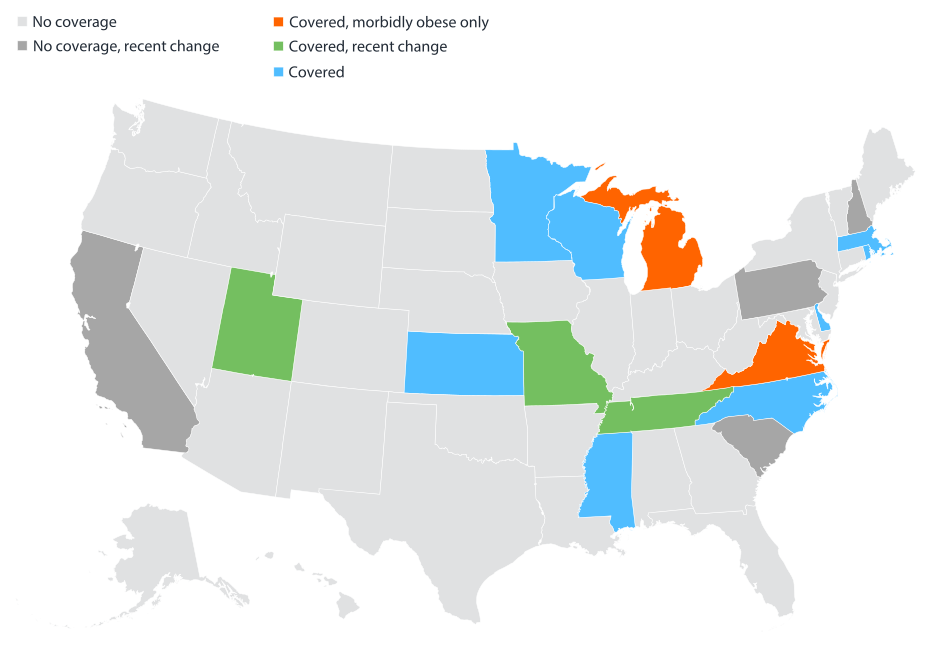
"Recent change" is relative to KFF’s August 2024 report. Williams, E., Rudowitz, R., & Bell, C. (2024, November 4). Medicaid coverage of and spending on GLP-1s. KFF. Retrieved March 10, 2026, from https://web.archive.org/web/20250826112929/https:/www.kff.org/medicaid/medicaid-coverage-of-and-spending-on-glp-1s/.
- After adding coverage of GLP-1s for weight loss August 1, 2024, North Carolina Medicaid reversed course to end coverage effective October 1, 2025, due to North Carolina Department of Health and Human Services (DHHS) anticipated “shortfalls in state funding” prompted by budget disagreements in the North Carolina General Assembly. North Carolina experienced a sharp increase in weight loss GLP-1 claims and spend in the first year following the implementation of coverage. Following legal challenges, DHHS reversed these reductions entirely, including the restoration of coverage for GLP-1 medications used for weight management effective December 12, 2025, by direct order of the governor.7,8
- South Carolina Medicaid added coverage of weight loss GLP-1s on November 1, 2024, and recently removed coverage effective January 1, 2026.9
- California Medicaid removed coverage effective January 1, 2026, in an effort to reduce pharmacy spending.10,11 California's spending on the three drugs approved for the weight loss indication increased fourfold from early 2024 to mid 2025, as outlined in Figure 2.
- New Hampshire Medicaid removed coverage effective January 1, 2026, citing these medications as a “significant cost driver.”12,13
- Pennsylvania Medicaid removed coverage effective January 1, 2026.14,15
Figure 2 summarizes gross costs for GLP-1 AOMs in these states, split by Medicaid fee-for-service (FFS) and managed care organization (MCO).
Figure 2: Gross expenditures on GLP-1 AOMs in states that recently terminated coverage, in $ millions
| QUARTER | CALIFORNIA | PENNSYLVANIA | NEW HAMPSHIRE | SOUTH CAROLINA | ||||
|---|---|---|---|---|---|---|---|---|
| FFS | MCO | FFS | MCO | FFS | MCO | FFS | MCO | |
| 2023 Q1 | $ 50.8 | $ 0.0 | $ 0.0 | $ 14.8 | $ 0.0 | $ 1.0 | $ 0.0 | $ 0.0 |
| 2023 Q2 | 83.6 | 0.0 | 0.1 | 34.1 | 0.0 | 1.2 | 0.0 | 0.0 |
| 2023 Q3 | 98.4 | 0.0 | 0.1 | 28.7 | 0.0 | 0.8 | 0.0 | 0.0 |
| 2023 Q4 | 65.3 | 0.0 | 0.1 | 24.6 | 0.0 | 0.6 | 0.0 | 0.0 |
| 2024 Q1 | 86.0 | 0.0 | 0.1 | 28.3 | 0.0 | 0.8 | 0.0 | 0.0 |
| 2024 Q2 | 131.9 | 0.0 | 0.1 | 54.4 | 0.0 | 1.7 | 0.0 | 0.0 |
| 2024 Q3 | 292.7 | 0.2 | 0.3 | 76.0 | 0.0 | 2.9 | 0.0 | 0.0 |
| 2024 Q4 | 298.8 | 0.2 | 0.4 | 89.3 | 0.0 | 4.0 | 0.0 | 0.3 |
| 2025 Q1 | 380.7 | 0.3 | 0.5 | 111.3 | 0.0 | 4.9 | 0.1 | 1.7 |
| 2025 Q2 | 399.5 | 0.3 | 0.6 | 131.8 | 0.0 | 5.6 | 0.1 | 3.6 |
| Total | $ 1,887.6 | $ 0.9 | $ 2.3 | $ 593.3 | $ 0.0 | $ 23.6 | $ 0.2 | $ 5.7 |
Gross expenditures for Wegovy, Zepbound, and Saxenda for all approved indications, including reducing the risk of MACE, MASH, and OSA. Data does not include the second half of 2025 when AOM coverage was largely still in place. Data summarized from Medicaid.gov. (2025, January 13). State drug utilization data. Retrieved March 10, 2026, from https://www.medicaid.gov/medicaid/prescription-drugs/state-drug-utilization-data.
The four states that removed coverage of GLP-1 AOMs for weight loss collectively spent approximately $2.5 billion on Wegovy, Zepbound, and Saxenda in a 30-month span, on a gross basis for all indications.16 However, a portion of spending on these therapies is expected to persist for the non-weight loss indications (e.g., major adverse cardiovascular events [MACE], metabolic dysfunction associated steatohepatitis [MASH], and obstructive sleep apnea [OSA]). For Medicaid members using GLP-1 AOMs in these states, coverage terminations may significantly limit the potential for sustained weight loss. Consequently, despite substantial upfront investment, state Medicaid programs may realize limited long-term cost savings or offsets, as treatment discontinuation reduces the likelihood of durable health and economic gains.17,18 However, some of these patients may have comorbidities (e.g., MACE, MASH, OSA) for which Medicaid coverage of the GLP-1 AOMs would persist.
At least two states changed their coverage criteria.
- Virginia Medicaid changed criteria, limiting coverage to individuals with a body mass index (BMI) greater than 40 or those with a BMI greater than 37 with weight-related comorbidities (defined as hypertension, type 2 diabetes, or dyslipidemia) effective July 1, 2024.19
- Michigan Medicaid also scaled back coverage, limiting utilization of GLP-1s for weight loss to those who are morbidly obese.20
Three states added coverage of GLP-1s with anti-obesity indications.
- Missouri Medicaid approved coverage in 2024.21
- Tennessee Medicaid approved coverage effective January 1, 2026.22
- Utah Medicaid began a one-year pilot starting July 1, 2025, for the FFS benefit only.23
The recent wave of state Medicaid agencies withdrawing or restricting coverage for AOMs, particularly GLP-1s, reflects a unique tension between groundbreaking clinical efficacy, rapid uptake, optional coverage, and immediate fiscal reality. Unlike most other FDA-approved drugs, coverage for agents used for weight loss is designated as an optional state benefit under the MDRP. This critical distinction makes AOMs the most immediate and accessible target when Medicaid administrators are forced to find budgetary savings to cover mandatory services. States have likely pulled back on AOM coverage due to the unprecedented adoption of GLP-1s, which triggered sharp increases in pharmaceutical spending. While studies and assessments of GLP-1 AOMs, such as the cost-effectiveness study by the Institute for Clinical and Economic Review (ICER),24 emphasize the potential for improved outcomes in obesity-related chronic diseases (e.g., heart disease, diabetes, osteoarthritis) and the potential related savings, the cost of AOMs must be paid up front, often exceeding the political or financial capacity of state legislatures to fund the program adequately. The states pulling back coverage all explicitly cited costs and budgetary concerns as the justification for cutting the optional benefit.
States that make the determination to continue covering these products with tighter restrictions on the eligible population, such as higher BMI thresholds for coverage, must balance the lower volume of eligible patients with the potential loss or reduction of supplemental rebate dollars from the manufacturer(s). The decision to scale back AOM coverage is likely less a commentary on the drugs’ clinical value and more a result of difficult budgetary considerations. Faced with a high-cost drug class hitting an optional budget line item, state Medicaid agencies were likely compelled to prioritize the immediate financial stability of the entire program.
Medicaid implications of recent U.S. government announcements on GLP-1 pricing
Most-favored-nation drug pricing
While several states have recently restricted or limited coverage of GLP-1 AOMs, efforts are being made at the federal level to ensure these drugs are more affordable for patients, as well as state Medicaid programs. On November 6, 2025, the president announced that agreements have been reached with Eli Lilly and Novo Nordisk, the manufacturers of the three available GLP-1s for weight loss, to reduce the drugs’ prices. The announcement stated that Wegovy and Zepbound (all doses and indications) will be available for $245 per month to state Medicaid programs. This announcement may prompt states to once again reconsider their coverage of GLP-1s for chronic weight management, given the availability of lower costs.25
Balance model
The Centers for Medicare and Medicaid Services (CMS) also announced the Better Approaches to Lifestyle and Nutrition for Comprehensive Health (BALANCE) model with aims to increase access to selected GLP-1s in Medicaid and Medicare. As part of this voluntary model, CMS will negotiate drug pricing and coverage terms with GLP-1 manufacturers on behalf of state Medicaid programs and Medicare Part D plan sponsors. For state Medicaid coverage, the price reductions will occur through supplemental rebate agreements between the state and manufacturers.26 State Medicaid agencies are able to participate in the model beginning May 2026 and Part D plans in January 2027. With potential Medicare Part D coverage, this may impact state Medicaid liability for dual-eligible members taking GLP-1 AOMs.
Conclusion: The outlook for state Medicaid coverage of GLP-1 AOMs
While 13 state Medicaid programs covered at least one GLP-1 approved for weight management as of August 2024, states subsequently reversed course: California, New Hampshire, Pennsylvania, and South Carolina recently withdrew coverage; Michigan and Virginia tightened eligibility to morbid obesity thresholds; and North Carolina briefly removed then reinstated coverage. At the same time, a few states expanded access (Missouri, Tennessee, and Utah), reflecting competing pressures between clinical demand and budgets. Looking forward, federal developments could shift states back toward coverage: the November 2025 announcement of most-favored-nation pricing and CMS’s BALANCE model will likely make these drugs more affordable for state Medicaid programs, potentially improving short-term cost-effectiveness. Until those initiatives are fully implemented, we expect states to continue balancing coverage with immediate budget risks as cuts to federal Medicaid spending from H.R. 1 (the Budget Reconciliation Act of 2025) take effect.
1 Darwish, R., Abu-Sharia, G., & Butler, A. E. (2025). History of glucagon-like peptide-1 receptor agonists. Pharmacological Research, 222, Article 108025. Retrieved March 10, 2026, from https://www.sciencedirect.com/science/article/pii/S1043661825004700.
2 VCUHealth. (2025, July 1). What do GLP-1 receptor agonists actually do? Retrieved March 10, 2026, from https://www.vcuhealth.org/news/what-do-glp-1-receptor-agonists-actually-do/.
3 Nania, R., (2025, December 23). FDA approves new weight loss pill. AARP. Retrieved March 10, 2026, from https://www.aarp.org/health/drugs-supplements/fda-approves-wegovy-weight-loss-pill/.
4 Payment for covered outpatient drugs. 42 U.S.C. § 1396r-8. Retrieved March 10, 2026, from https://uscode.house.gov/view.xhtml?req=granuleid:USC-1999-title42-section1396r-8&num=0&edition=1999.
5 Emmerich, S. D., Fryar, C. D., Stierman, B., & Ogden, C. L. (2024, September). Obesity and severe obesity prevalence in adults: United States, August 2021–August 2023 [NCHS Data Brief No. 508]. National Center for Health Statistics. Retrieved March 10, 2026, from https://www.cdc.gov/nchs/products/databriefs/db508.htm.
6 Williams, E., Rudowitz, R., & Bell, C. (2024, November 4). Medicaid coverage of and spending on GLP-1s. KFF. Retrieved March 10, 2026, from https://web.archive.org/web/20250826112929/https:/www.kff.org/medicaid/medicaid-coverage-of-and-spending-on-glp-1s/.
7 North Carolina Medicaid, Division of Health Benefits. (2025, December 19). NC Medicaid to reinstitute coverage of GLP-1s for weight management [Bulletin]. Retrieved March 10, 2026, from https://medicaid.ncdhhs.gov/blog/2025/12/19/nc-medicaid-reinstitute-coverage-glp-1s-weight-management.
8 Eanes, Z. (2026, January 20). Demand for GLP-1s from North Carolina Medicaid patients has grown significantly. Axios. Retrieved March 10, 2026, from https://www.axios.com/local/raleigh/2026/01/20/medicaid-glp-1-weight-loss-north-carolina-prescription-claim.
9 Chatlani, S. (2025, January 7). As demand for weight-loss drugs rises, states grapple with Medicaid coverage. South Carolina Daily Gazette. Retrieved March 10, 2026, from https://scdailygazette.com/2025/01/07/as-demand-for-weight-loss-drugs-rises-states-grapple-with-medicaid-coverage/.
10 Medi-Cal Rx. (2025, October 21). Important update: GLP-1s for weight loss are not a covered benefit. Retrieved March 10, 2026, from https://medi-calrx.dhcs.ca.gov/cms/medicalrx/static-assets/documents/provider/publications/2025.10_A_Important_Update_GLP-1s_Weight_Loss_Not_Covered_Benefit.pdf.
11 Thompson, D. (2026, January 9). California ends Medicaid coverage of weight loss drugs despite TrumpRx plan. KFF Health News. Retrieved March 10, 2026, from https://kffhealthnews.org/news/article/california-medicaid-medi-cal-glp1-weight-loss-drugs-ends-coverage-cost/.
12 NH Healthy Families. (2025, October 14). GLP-1 medications change in coverage effective January 1, 2026 [Press release]. Retrieved March 10, 2026, from https://www.nhhealthyfamilies.com/newsroom/glp-1-medications-change-in-coverage-effective-january-1--2026.html.
13 Skipworth, W. (2025, December 5). Medicaid to stop covering weight-loss drugs for obesity in New Hampshire. New Hampshire Bulletin. Retrieved March 10, 2026, from https://newhampshirebulletin.com/2025/12/05/medicaid-to-stop-covering-weight-loss-drugs-for-obesity-in-new-hampshire/.
14 Caruso, S. (2025, December 9). Pennsylvania restricts weight-loss drugs for Medicaid patients amid budget woes. Spotlight PA. Retrieved March 10, 2026, from https://www.spotlightpa.org/news/2025/12/ozempic-glp1-weight-loss-medicaid-pennsylvania-cuts-health/.
15 Pennsylvania Department of Human Services. (2025, November 24). Coverage change and prior authorization of GLP-1 receptor agonists (formerly hypoglycemics, incretin mimetics/enhancers and obesity treatment agents) – pharmacy services [Medical assistance bulletin]. Retrieved March 10, 2026, from https://www.pa.gov/content/dam/copapwp-pagov/en/dhs/documents/docs/publications/documents/forms-and-pubs-omap/mab2025112403.pdf.
16 For the majority of the period depicted in Figure 2, chronic weight management was the sole approved indication for Wegovy, Zepbound, and Saxenda. Moreover, the population eligible for GLP-1 AOMs is substantially larger than the populations diagnosed with established cardiovascular disease + obesity/overweight, MASH, or OSA. Consequently, only a limited portion of the expenditures shown in Figure 2 is attributable to non-obesity-related indications.
17 West, S., et al. (2026, January 7). Weight regain after cessation of medication for weight management: Systematic review and meta-analysis. BMJ, 392, Article e085304. Retrieved March 10, 2026, from https://www.bmj.com/content/392/bmj-2025-085304.
18 Khan, S.S., Ndumele, C.E., & Kazi, D.S. (2024, November 13). Discontinuation of glucagon-like peptide-1 receptor agonists. JAMA, 333(2), 113–114. Retrieved March 10, 2026, from https://jamanetwork.com/journals/jama/article-abstract/2826198.
19 State of Virginia. (2024). Limit weight loss medications in Medicaid (language only). Budget Amendments - HB30 (Conference Report). Retrieved March 10, 2026, from https://budget.lis.virginia.gov/amendment/2024/1/HB30/Introduced/CR/288/12c/.
20 Newman, E. (2025, October 20). Michigan cuts off weight-loss drugs for most Medicaid patients, saving $240M. Bridge Michigan. Retrieved March 10, 2026, from https://bridgemi.com/michigan-health-watch/michigan-limits-access-to-weight-loss-drugs-for-medicaid-patients/.
21 Missouri Department of Social Services. (2024, October 15). GLP-1 receptor agonists indicated for obesity PDL edit October 15, 2024. Retrieved March 10, 2026, from https://mydss.mo.gov/media/pdf/glp-1-receptor-agonists-indicated-obesity-pdl-edit-october-15-2024.
22 State of Tennessee Division of TennCare. (n.d.). [Notice of changes for the TennCare pharmacy program]. Retrieved March 10, 2026, from https://contenthub-aem.optumrx.com/content/dam/contenthub/onboarding/assets/Tenncare/Provider-Notice-Weight-Management-Updates-12-01-25.pdf.
23 Utah Department of Health and Human Services. (n.d.). 2025 Medicaid statewide provider training [Slide deck]. Retrieved March 10, 2026, from https://medicaid-documents.dhhs.utah.gov/C3%2F2025%2FSWPT+2025+-+Pharmacy+Program+Slides.pdf.
24 Lin, G. A., Lee, W., Fahim, S. M., Richardson, M., Phillips, M., Raymond, F., & Rind, D. (2025, September 9). Semaglutide and tirzepatide for obesity: Effectiveness and value—draft evidence report. Institute for Clinical and Economic Review. Retrieved March 10, 2026, from https://icer.org/wp-content/uploads/2025/09/ICER_Obesity_Draft-Report_For-Publication_090925.pdf.
25 White House. (2025, November 6). President Donald J. Trump announces major developments in bringing most-favored-nation pricing to American patients [Fact sheet]. Retrieved March 10, 2026, from https://www.whitehouse.gov/fact-sheets/2025/11/fact-sheet-president-donald-j-trump-announces-major-developments-in-bringing-most-favored-nation-pricing-to-american-patients/.
26 Centers for Medicare and Medicaid Services. (2025, December). Better Approaches to Lifestyle and Nutrition for Comprehensive hEalth (BALANCE) model: Request for applications, manufacturer. Retrieved March 10, 2026, from https://www.cms.gov/priorities/innovation/files/balance-rfa.pdf.