Introduction: Why fragmented data is preventing life sciences companies from adopting AI
Generative artificial intelligence (AI) is rapidly influencing how life sciences organizations operate. Many teams see clear opportunities to use AI to summarize payer policies, prepare for negotiations, and identify new access opportunities.
At the same time, many of these efforts fall short, in part because of the way data is organized and managed.
In market access, one of the biggest barriers to AI adoption is trust in the results. That lack of trust can be driven by fragmented managed care data. Information about payers, plans, coverage requirements, and contracting outcomes frequently lives across disconnected systems, forcing both humans and AI tools to make assumptions.
Life sciences companies can take three practical steps to build a stronger data foundation for AI:
- Create a unified payer and account hierarchy
- Standardize coverage and access data
- Establish governance and stewardship for managed care data
Step 1: Create a unified healthcare payer and account hierarchy to strengthen the underlying data for AI
A unified payer hierarchy provides a consistent structure that connects parent payer organizations, individual health plans, and pharmacy benefit managers (PBMs) (Figure 1).
Figure 1: Example payer hierarchy
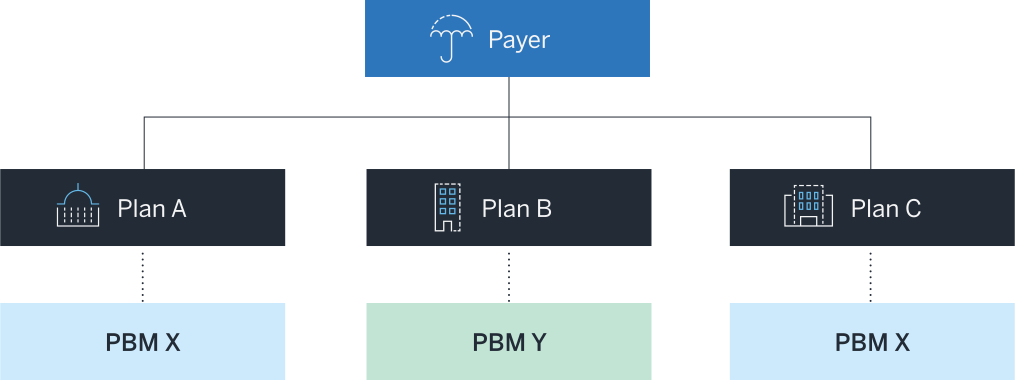
When identifiers and relationships are aligned to industry-standard language, AI tools are better able to aggregate insights across plans and identify patterns within payer organizations.
As organizations develop their AI strategies, it is important to test how well the hierarchy supports consistent outputs. For example:
- Are payer- and account-level key performance indicators (KPIs) calculated consistently, even with small variations in prompts?
- Do transactions and covered lives align with expectations, particularly when subsidiaries are involved?
- Can AI move up and down the hierarchy to understand drivers and produce roll-ups without losing context?
- Can AI correctly interpret provider-to-facility relationships when multiple affiliations exist?
Because organization structures and data sources continue to evolve, this hierarchy should not be treated as static. A well-maintained, “living” hierarchy becomes increasingly important as AI use expands.
Step 2: Standardize healthcare coverage and access data
Structured access data is what allows AI systems to perform meaningful analyses. Although many data vendors have improved how coverage data is organized, life sciences manufacturers often need additional standardization or translation for their specific use cases.
A key challenge is that much of today’s access data was originally designed for human interpretation. However, business logic embedded in free text or shorthand notes can create ambiguity when read by large language models.
This is especially true in areas such as specialty drugs and oncology, where important details often sit in unstructured fields that reflect copy–paste workflows or inconsistent documentation. Organizations can choose to rely on AI to interpret this variation, or they can take steps to standardize the data upfront. In practice, most will need a combination of both.
For organizations looking to use AI to process primary-source coverage documents, progress is being made but challenges remain. Coverage policies are often embedded in PDFs or patient-facing lookup tools. Even when the correct source is identified, extracting the relevant details can require navigating multiple layers of references and tables. For most analytical purposes, these details ultimately need to be grouped into a manageable set of meaningful categories. AI can support this categorization, particularly when guided by clear definitions of what matters most to the business.
There is also opportunity to introduce additional context into the data. Coverage structures vary widely across plans. For example, not all plans use the same number of tiers or define “preferred” coverage the same way. Without clear definitions, AI outputs will only be as reliable as the underlying business logic.
Evaluating primary sources is typically handled in batch cycles (monthly updates are common), though more frequent updates may be needed when significant changes occur. As AI becomes more integrated into these workflows, organizations should account for variability in outputs by comparing results across runs and incorporating measures of confidence.
Although the speed of insight has increased with AI, the underlying need for consistent data has not changed. A stable data model built on clear facts, dimensions, and measures remains essential for understanding performance, evaluating change, and supporting decision-making.
Step 3: Establish governance and stewardship for managed care data
As AI tools make it easier to build complex solutions, the importance of governance becomes even more pronounced. Although technology has advanced, the principles of good data management remain largely unchanged.
AI systems rely on the same foundational concepts that have supported data analytics for decades. Logical data structures, clear definitions, and well-designed data models are still critical. In many ways, success with AI still depends on answering a familiar question: What does a well-structured, understandable data environment look like?
However, a shift is occurring in how analytics are delivered. Tasks that once required manual effort—such as writing custom queries or generating reports—are increasingly handled by AI systems. But enabling those systems to perform effectively still requires the same preparation that supported human analysts in the past. This includes maintaining strong documentation, such as data dictionaries and measure definitions, and ensuring that this information is accessible to both AI systems and users.
In addition, organizations should consider how to integrate structured data with the broader context of the business. AI tools become significantly more valuable when they can draw not only from curated data marts but also from relevant unstructured sources, such as internal communications, strategy documents, or project notes. In some cases, getting the most out of AI may require actively curating and maintaining contextual information rather than relying on ad hoc access.
Finally, governance must evolve to include AI-specific considerations. Building trust in AI outputs requires transparency, traceability, and clear sourcing.
Conclusion: How life sciences companies can leverage managed care data and gain AI-driven insights
AI is reshaping how life sciences companies approach market access. However, the effectiveness of these tools depends heavily on the quality and structure of managed care data.
By focusing on unified payer hierarchies, standardized coverage data, and strong governance practices, organizations can build a foundation that supports more reliable, scalable AI-driven insights.