The European life insurance industry has continued to adapt to, and reflect on, the impacts of climate and broader sustainability-related risks on their business strategy and solvency capital.
With the UK Prudential Regulation Authority’s (PRA’s) recent Supervisory Statement (SS) 5/25 and ongoing efforts from the European Insurance and Occupational Pensions Authority (EIOPA) and national regulators, climate risk management remains a key focus for many European life insurers.
However, there is only limited pan-European information to consider how different life insurers approach climate risk when it comes to their own risk and solvency assessments (ORSAs). Whilst recent years have brought critiques on whether standard industry models fully represent future risks, there is little data to demonstrate how the life insurance industry as a whole has responded.
Following on from our work modelling the potential influence of sustainability risks on inflation scenarios, Milliman conducted its first ORSA sustainability benchmarking survey, which sought to understand current practices in the European life insurance industry.
Background on the 2025 ORSA sustainability survey
Our 2025 ORSA sustainability survey was conducted across Europe from May 2025 to June 2025 with 33 respondents in total, including responses from the UK, Ireland, Belgium and the Netherlands. The survey participants ranged in size, with 50% above €20bn in assets under management.
The survey assessed how firms are responding to the intersection of climate-driven inflation and ORSA. The survey aimed to:
- Benchmark current industry practices on integrating climate inflation into risk management and ORSA processes.
- Identify common challenges, data and methodology gaps, and the extent of macro-economic considerations.
- Highlight advanced practices and innovative approaches, as well as areas where the industry is lagging.
- Support insurers in meeting the continually evolving regulatory landscape and building resilience against climate-related financial risks.
This survey builds upon Milliman’s broader research on climate risk quantification, complex risk analysis and financial materiality in climate risk management.
As with any voluntary survey, the participation, and therefore the results, will likely be biased towards those most interested in sustainability. However, we believe the responses give a useful picture of industry trends, even if they don’t reflect exact proportions, especially since people tend to overstate their sustainability efforts.
Following is a summary of key findings from our 2025 ORSA sustainability benchmarking survey.
How far along are European life insurers when it comes to implementing sustainability-related risks into their solvency frameworks?
There were three sets of core findings from the survey relating to climate risks, other sustainability risks and the key challenges.
Firstly, the integration of climate-related risks is well established, although there are large variations in its implementation:
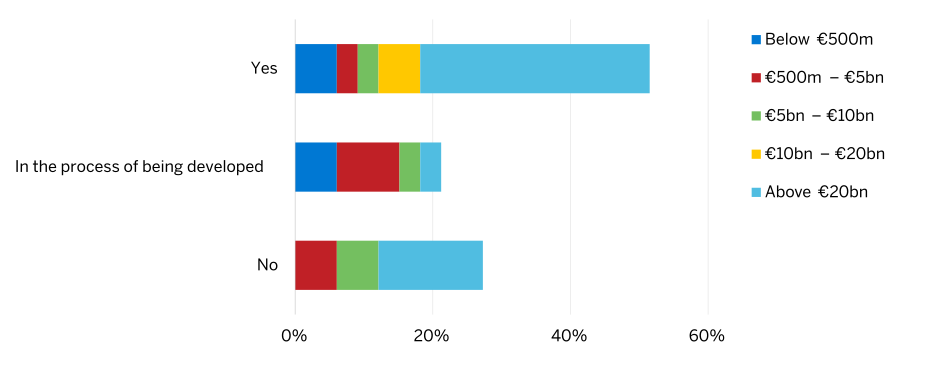
- Around 70% of boards aim to have approved climate targets by next year. Progress was reflected in more than 50% of respondents integrating climate-related risks into core risk areas—asset, credit, liability, operational, reputation and strategic risks. Although, a third of respondents did not integrate climate-related risks into one or more of their credit, liability, operational, strategic or underwriting risk processes.
Question: Does your company have a board-approved climate transition strategy set for 2030 or later?
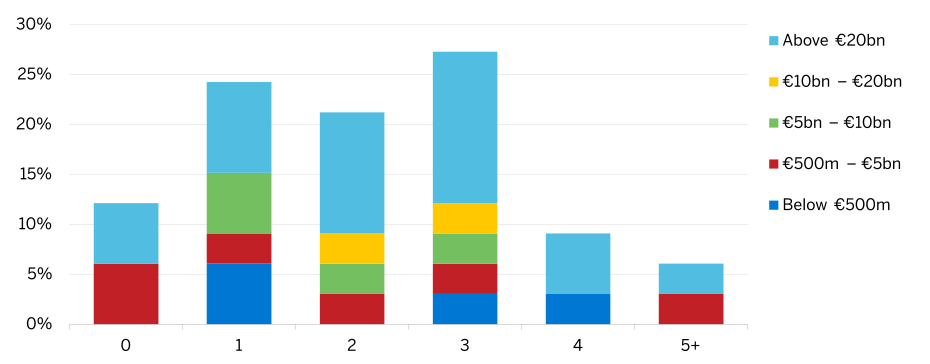
- There were significant variations in the number of ORSA scenarios used—from fewer than five to 15-plus. The number of scenarios covering sustainability ranges from none to more than five. Whilst most consider climate-related impacts in investments, the impact on other functions (capital, enterprise risk management [ERM], liabilities, operations) was more mixed (30%–50%).
Question: How many scenarios are included in your company’s orsa each year?
- Macro-economic variations used in scenarios were particularly large. Shifts in interest rates range from none to more than 275 basis points (bps) with only a small number considered a “spike” in rates; although, some of those had spike stresses of more than 1,000 bps.
Secondly, it was clear there were limited existing efforts beyond climate; although, these are increasing:
- Less than 25% of respondents’ boards currently have approved targets for labour rights, human rights, nature or inequality/inclusion. Similarly, less than 25% of respondents had integrated these factors into their key risks.
Question: Does your company have a board-approved sustainability strategy with targets set for 2030 or beyond?
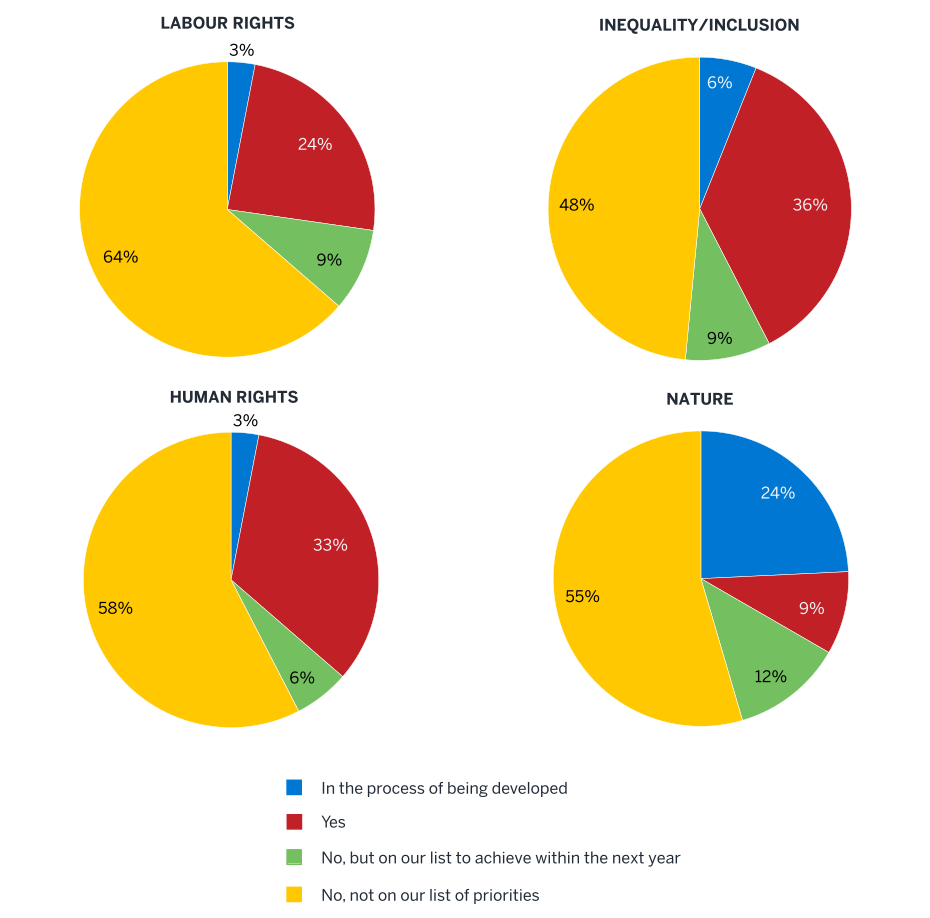
- However, there was a significant interest in increasing these efforts. For example, one-third of respondents were in the process of developing board targets for human rights and inequality/inclusion. UK respondents had the most interest in increasing nature-related targets, with this expected to rise to two-thirds of respondents by the end of next year.
Finally, modelling capabilities and relevant data were the biggest stated challenges for climate and sustainability-related risks, closely followed by applicability of time horizon and determining the stresses to apply.
Do European life insurers' ORSA scenarios and stress tests reflect the potential macro-economic impacts of a sustainable future?
One of the key findings was the extremely wide range of assumed macro-economic impacts. More than 50% of the firms’ inflation and interest rate stresses were under 125 bps, which contrasts with others that were above 250 bps on a level basis and more than 750 bps on a shock basis.
Milliman’s sustainability inflation scenario model
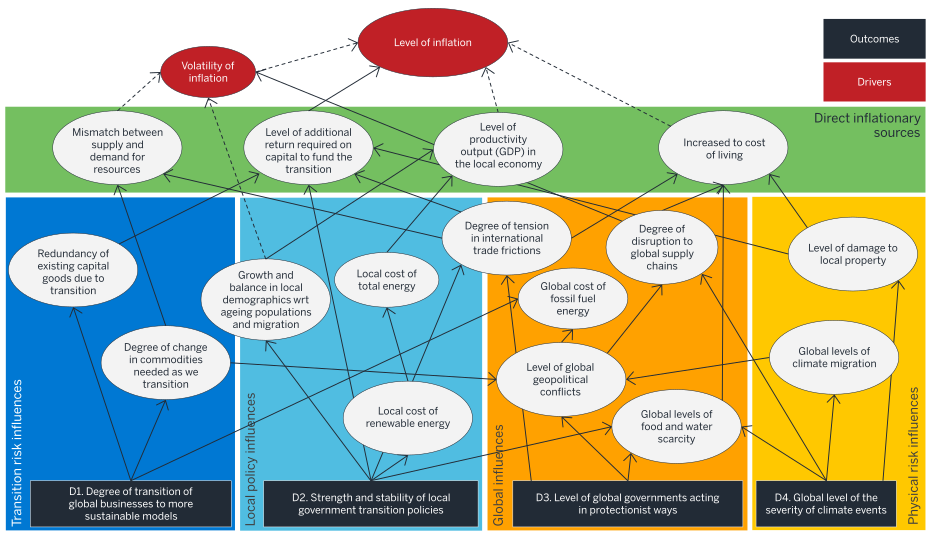
- Milliman’s sustainability inflation scenario model1 has been developed to consider and explore potential inflation outcomes allowing for sustainability risk factors and geopolitical influences.
- Plausible scenarios, which start with weakening confidence in the direction of government policy and increasing demand for new commodities, show rising levels of inflation which may then be exacerbated by further geopolitical tensions. Such a set of circumstances could lead to central cases with 135 bps increases in inflation and increases of more than 1,000 bps in stress scenarios.
- These sustainability transition influences would seem to be captured by the respondents reflecting high levels of inflation shifts and “spikes” in their sustainability scenarios. However, it is less clear whether those who responded with less than 125 bps have captured these impacts.
Extract of Milliman’s sustainability inflation scenario model
What are the advanced practices that leading European life insurers are already implementing around sustainability and modelling?
The increasing intentions around having board-level targets show that climate and sustainability efforts are still an emerging area of focus and development. Whilst there was a range of maturity levels, several respondents had embedded climate and (to a lesser extent) other sustainability risk management across various aspects of the business, which can be seen as emerging best practice:
- Adoption of material macro-economic impacts that are integrated into their ORSA climate-related risks scenarios
- Consideration of climate-related risks across all business disciplines and risk types, alongside a wide use of different scenarios for ORSA considerations, with some considering five or more different sustainability scenarios
- Emerging focus on non-financial risks, with broader interest in developing board targets for social-related risks along with the two-thirds of UK insurers expected to have nature-related board targets by the end of next year
However, the survey also identified a range of practices and where there is scope for future development:
- More than a third of respondents had not integrated climate-related risks across at least one risk types and business functions.
- Thirty percent of respondents don’t explicitly consider sustainability-related inflation impacts, and it’s unclear whether a sufficiently sized quantum is considered by the majority of respondents.
- There were limited consideration and integration of non-climate-related sustainability risks (nature, human rights, labour rights and inequality/inclusion).
- There was significant reliance on Network for Greening the Financial System (NGFS) scenarios, and it was unclear how respondents dealt with these scenarios’ stated limitations2 in areas such as tipping points, connected impacts and physical risks. The need to explicitly consider scenario limitations has been highlighted in Institute and Faculty Risk Alerts3 and the UK PRA’s SS 5/25.4
What practical steps should insurers take next?
Based on the survey findings and Milliman’s broader research, life insurers seeking to develop best practices around sustainability risk might benefit from:
- Embedding forward-looking, scenario-based approaches to climate-driven inflation and macro-economic risk in ORSA and strategic planning.
- Strengthening cross-functional collaboration and risk integration: to incorporate all business functions and risk types.
- Greater investment in data, analytics and partnerships in particular to diversify from reliance on NGFS scenarios and to develop broader perspectives on risks.
- Treat macro-economic impacts of sustainability risks as a central concern—not peripheral—to reflect prospective views and ensure quantum of shocks are appropriate.
Summary: Why this matters for the future of insurance
The life insurance industry stands at a critical juncture. With climate change accelerating macro-economic volatility, prudent insurers are already embedding climate and macro-economic risks into their ORSA and strategic frameworks. However, many firms remain at risk of underestimating these threats. Industry-wide adoption of robust, scenario-driven approaches is essential for building resilience and meeting the demands of regulators, shareholders and society.
For more insights and guidance, see Milliman’s latest research papers on climate risk and macro-economic scenario analysis. In particular, these papers provide insights on forward-looking risk-based approaches and ways to diversify from reliance on NGFS scenarios, support cross-functional collaboration and highlight the central impacts of macro-economic risks. They support the development of climate and sustainability modelling capabilities and illustrate ways that uncertainties and data challenges can be addressed.
Please reach out to the authors below, or your usual contacts, for further details and to obtain a copy of the full survey.
1 Spencer, N. & Drew, A. (9 January 2025). The rise and fall: Climate change and inflation modelling. Available from https://www.milliman.com/en/insight/rise-and-fall-climate-change-inflation-modelling.
2 Network for Greening the Financial System. (November 2024). NGFS long-term scenarios for central banks and supervisors. Retrieved 5 January 2026 from https://www.ngfs.net/system/files/import/ngfs/media/2024/11/05/ngfs_scenarios_high-level_overview.pdf.
3 Institute and Faculty of Actuaries. (6 June 2024). IFoA Risk Alert on climate change scenario analysis. Retrieved 5 January 2026 from https://actuaries.org.uk/news-and-media-releases/news-articles/2024/jun/06-jun-24-ifoa-risk-alert-on-climate-change-scenario-analysis/.
4 Prudential Regulation Authority. (3 December 2025). SS5/25 – Enhancing banks’ and insurers’ approaches to managing climate-related risks. Bank of England. Available from https://www.bankofengland.co.uk/prudential-regulation/publication/2025/december/enhancing-banks-and-insurers-approaches-to-managing-climate-related-risks-ss.