Since 2025, the Inflation Reduction Act of 2022 (IRA) has required pharmaceutical manufacturers to provide discounts on applicable drugs, primarily brand-name products, for Medicare Part D beneficiaries once annual drug spending exceeds the standard Part D benefit deductible. With the Centers for Medicare and Medicaid Services (CMS) making it explicit that this Manufacturer Discount Program (MDP) applies to PACE organizations (POs),1 the program changes how Part D costs are financed and introduces new cash flow and reconciliation considerations for POs.
Overview of the MDP
Figure 1 outlines the manufacturer discount percentages by spending level.
Figure 1: 2026 thresholds and MDP percentages by member spending level
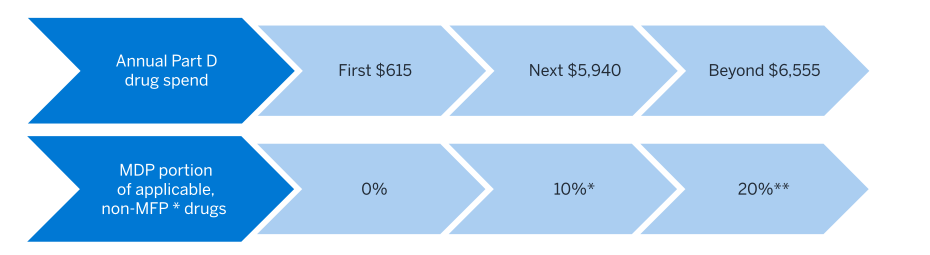
* MDP discounts do not apply to selected drugs with negotiated prices under the IRA’s Maximum Fair Price (MFP) provision (which was first effective in 2026).
** 2% phase-in percentage in 2026 (percentage varies in future years) for specified manufacturers when the drug is dispensed to a low-income beneficiary and specified small manufacturers for all beneficiaries.1
Operationalization of the MDP: An overview for PACE programs
We describe the operationalization of the MDP in two tracks:
- The first track describes the MDP prospective payments and reconciliation.
- The second track describes the manufacturer invoicing and how manufacturer payments affect POs.
Track 1: CMS MDP subsidy, PDE reporting, and reconciliation
CMS includes estimated MDP amounts in each PO’s monthly Part D payment through the MDP subsidy. In effect, CMS prospectively advances an estimate of expected manufacturer discount cost and then reconciles that to actual experience later.
Figure 2: CMS MDP payments to POs
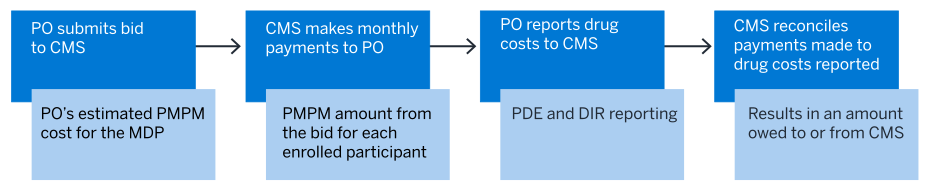
Figure 2 summarizes the payment mechanics:
- CMS pays each PO a monthly Part D amount that includes an estimated MDP subsidy. This estimate is developed through the Part D bid process.
- Throughout the year, each PO reports drug costs by submitting prescription drug event (PDE) records for each prescription filled and any direct and indirect remuneration (DIR). The PDE data includes the MDP portion of each Part D drug.
- After year-end, CMS reconciles the total MDP subsidy payments to MDP amounts reported in the PDE data.
This CMS reconciliation framework is separate from the manufacturer cash transfers described below.
Track 2: Manufacturer invoicing and CMS recovery of manufacturer payments
Because the IRA and MDP prohibit CMS from directly receiving or distributing any manufacturer funds, POs effectively serve as a clearinghouse for the manufacturer payments to CMS, as illustrated in Figure 3.
Figure 3: CMS collection of MDP amounts from manufacturers
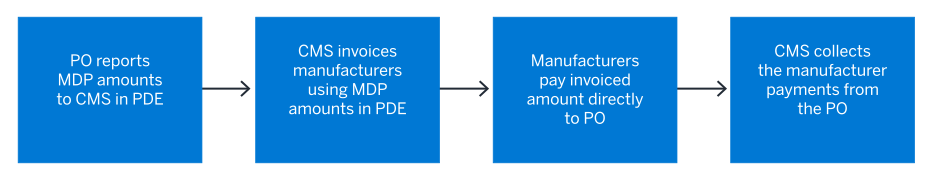
- After the end of each quarter, CMS invoices the manufacturers using the MDP amounts in the PO’s PDE data.
- Manufacturers pay invoiced amounts to the PO.
- CMS recovers those manufacturer-paid amounts by reducing subsequent monthly Part D payments to the PO.
How PACE organizations should monitor the tracks of the MDP
POs should maintain separate monitoring for:
- CMS MDP subsidy payments, PDE-based MDP amounts, and year-end reconciliation items (Track 1)
- Manufacturer-invoiced amounts, manufacturer payments received, and CMS monthly payment recoveries (Track 2)
Separating these tracks helps promote transparency and supports a more accurate reserve analysis, which may be especially important because:
- Manufacturers generally have up to 38 days from invoice receipt to pay undisputed amounts.
- CMS may apply payment reductions before all manufacturer remittances are received.
- PDE records, and therefore MDP amounts, may be added, adjusted, or deleted after initial submission.
Oversight of the MDP for PACE organizations
For POs, the MDP represents more than a technical change in pharmacy financing. PO management oversight and ongoing activity (if not already implemented) should include the following actions:
- Confirm that financial reporting reflects the impact of the MDP and accompanying reconciliation/reserves.
- Request and review regular operational updates and issues.
- Meet periodically with PBMs and other contractors to identify and resolve operational problems promptly and assess the ongoing sufficiency of those relationships.
- Review claims, reconciliation, and other trends for emerging operational or financial risk.
- Report on any material impact on pharmacy spending overall and the PO’s liability.
- Verify that processes are in place to address any new or recurring issues affecting participant access or payment accuracy.
Anecdotally, POs point to regular reviews of experience and proactive communication with PBMs and other contractors as particularly critical oversight pieces. Management oversight of implementation readiness and ongoing execution, operational coordination, relationships with other parties, and the evolving financial impact are all important as this redesigned Part D framework matures.
How Milliman can help
Milliman provides PACE organizations with reserving and modeling insights and tools to track actual versus expected Part D drug costs and estimate Part D payment reconciliation amounts. The reserve model available for use tracks MDP-specific information to provide timely estimates of the subsidy reconciliation and MDP cash flow throughout the year, consistent with CMS guidance. Milliman’s insight and this real-time tool help PACE organizations understand and accurately accrue for the impact of the MDP and related reserves. For more information, please contact your Milliman PACE consultant.
1 Centers for Medicare and Medicaid Services. (2024, December 20). Revised Medicare Part D Manufacturer Discount Program final guidance. Retrieved October 26, 2026, from https://www.cms.gov/files/document/manufacturer-discount-program-final-guidance.pdf.