Introduction
Reserve setting and financial reporting for Medicare Part D plans has entered a new phase of complexity. The Inflation Reduction Act of 20221 (IRA) reshaped the Medicare Part D program through extensive benefit redesign, altered liability structures, and the new manufacturer discount program. These changes have material implications for health plan finances and solvency. To help actuaries, finance teams, and executives manage these changes, this paper will:
- Briefly recap the key shifts in the Medicare Part D landscape post-IRA, including changes in benefit and cost structures
- Highlight the key components of Medicare Part D settlements and the shifts in financial outcomes for Part D plans
- Discuss key considerations for accurate projections and timely adjustments to avoid financial setbacks
Summary of IRA changes affecting Part D settlements
Part D benefit redesign
The IRA represents the most sweeping overhaul of Medicare Part D since the program’s inception, fundamentally altering benefit design, risk allocation, and cash flow timing for plan sponsors. The most impactful changes affecting Part D settlements include the new Maximum Out-of-Pocket (MOOP) limit and changes in payer liability across the benefit phases.
- MOOP change: Beginning in 2025,2 member out-of-pocket spending is capped at $2,000 annually, a significant decrease from the previous structure (a $7,400 catastrophic threshold in 2023, with 5% member liability thereafter).
- Phase change: The Coverage Gap Phase (commonly referred to as the “donut hole”) is eliminated.
- Drug manufacturer responsibility change: The Coverage Gap Discount Program (CGDP) is replaced by the Manufacturer Discount Program (MDP).
- Liability changes: Plan liability in the catastrophic phase increases from 15% in 2023 to 60% in 2025 and beyond.3 Simultaneously, Centers for Medicare and Medicaid Services (CMS) reinsurance shrinks from 80% to 20% for brand drugs and to 40% for generic drugs,4 reflecting a broader shift of federal financial responsibility from reinsurance to higher direct subsidy payments.
Cash flow patterns and seasonality
While actual payer liability is incurred as each script is filled, the Part D plan sponsor receives payments on a different schedule. During each month of the contract year, in addition to the risk-adjusted direct subsidy, CMS prospectively pays the plan monthly subsidies for federal reinsurance, Low-Income Cost Sharing (LICS) subsidy, MDP, and selected drug subsidy, as estimated in the plan’s bids. After the close of the calendar year, actual costs, rebates, and risk scores are finalized. The difference between the actual liabilities and the prospective subsidy payments (excluding the direct subsidy) are reconciled with CMS and the manufacturers. In addition, if actual plan experience diverges sufficiently from the bids, there may be a Part D risk corridor payment or receivable.
Because final settlements are not made until well after the contract year closes, plan sponsors need to estimate the settlement amounts in order to properly book gains or losses and establish reserves if necessary.
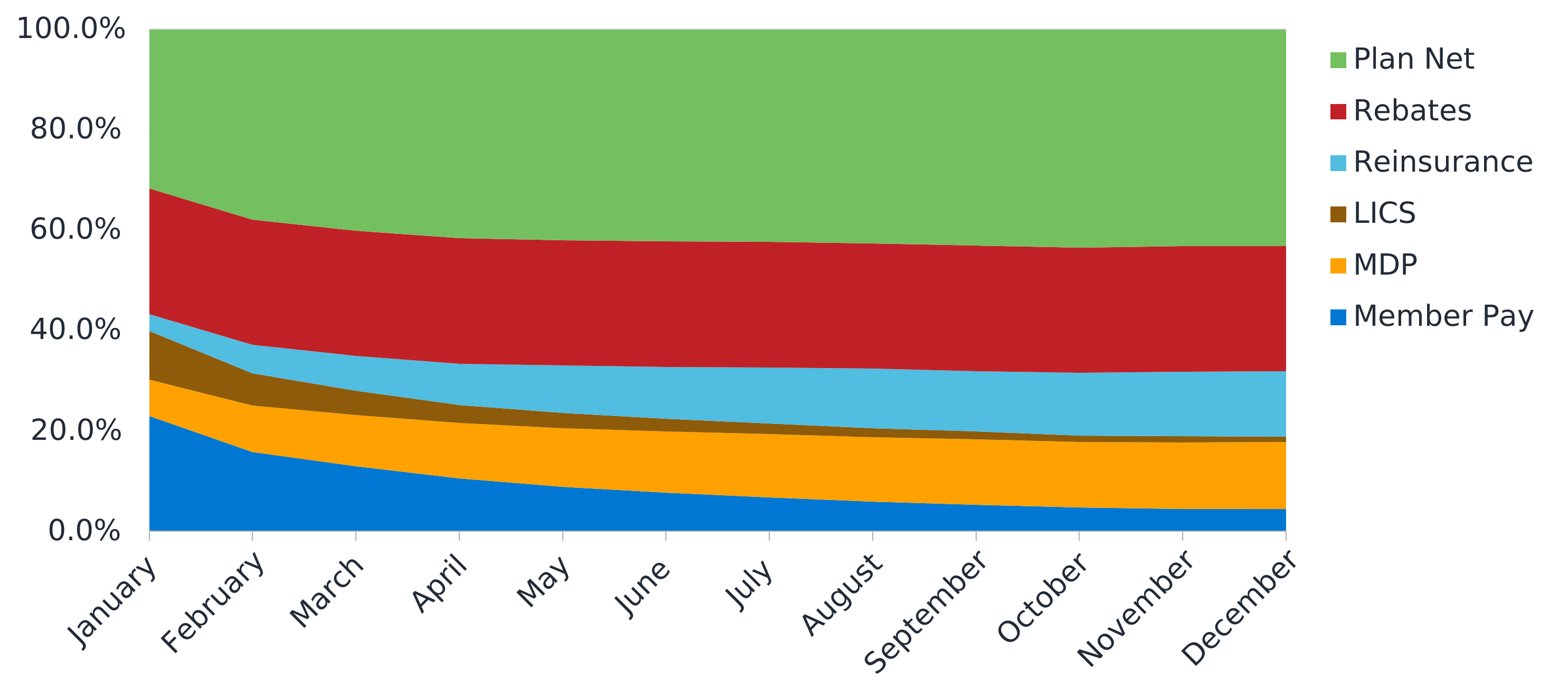
The IRA benefit redesign substantially changes monthly incurred liability patterns and cash flow timing for each of the four main payers (members, manufacturers, plans, and the federal government). Historical patterns from before 2025 are no longer applicable to forecasting cash flows or estimating Part D settlements.
- Enrolled members: The cap on out-of-pocket spending results in average member responsibility decreasing more rapidly throughout the year. Note this analysis excludes the effect of the Medicare Prescription Payment Program, which smooths out member payments throughout the year at the expense of the plan.
- Manufacturers: Manufacturers experience a steady increase in average liabilities throughout the year, as the MDP now extends their financial responsibility into the catastrophic phase, rather than being limited to prescriptions in the coverage gap phase.
- CMS: The federal government sees average reinsurance payments grow at a slower pace, while LICS subsidies decrease sharply.
- Part D plans: Previously benefiting from reduced liabilities as members transitioned out of the initial coverage phase, now plans face growing average liabilities throughout the year as they share the majority of costs in the catastrophic phase.
The following charts provide an illustrative example of how liabilities are distributed throughout the year, highlighting the seasonal shifts in cash flows before and after the IRA. Figure 1 displays the liability attributed to each stakeholder and component of total liability in a pre-IRA redesign environment (2023). Figure 2 shows the same information in a post-IRA redesign environment (2025).
In the next section, we discuss in more detail the components of Part D cash flows and settlements and the IRA impact on each.
Figure 1: Distribution of payer liability by incurred month – 2023 design
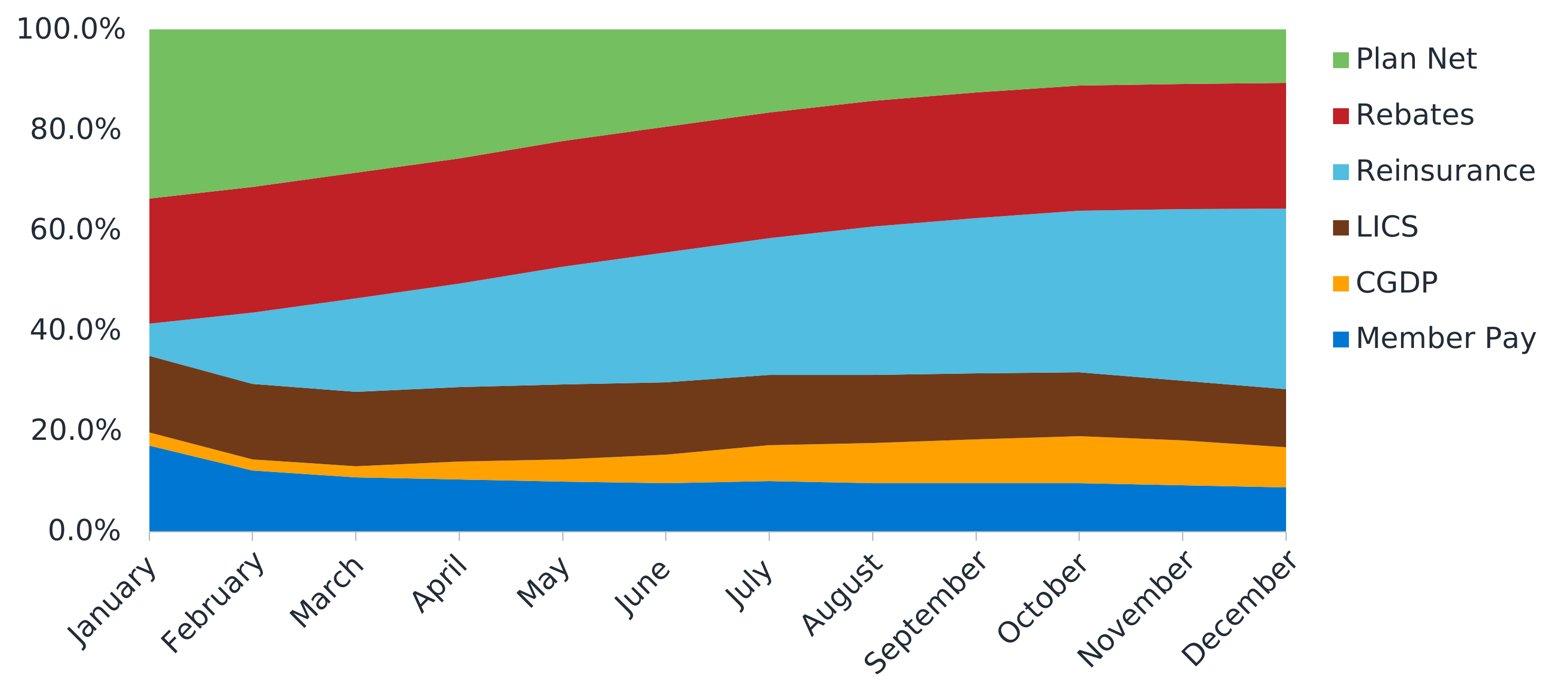
Figure 2: Distribution of payer liability by incurred month – 2025 design
2023 example: adjudicated a manual rate based on a 2023 enhanced benefit design of $4 / $9 / $44 / 43% / 30% with a $195 deductible.
2025 example: adjudicated a manual rate based on a 2025 enhanced benefit design of $4 / $8 / 22% / 45% / 30% with a $275 deductible.
Components of Part D settlements
Direct subsidy
The direct subsidy paid for each member is adjusted for the member’s Part D risk score; the amount paid equals the risk score times the plan bid amount minus the basic member premium. For a member with 1.0 risk score, the amount paid equals the national average direct subsidy (the difference between the national average monthly bid amount and the national base beneficiary premium). Each member’s risk score for the plan year is updated during the “risk score sweeps” as CMS shifts the underlying risk score diagnosis time frame and incorporates additional diagnosis information. This typically leads to additional payments received by the plan in July of the contract year and in the following July.
In recent years prior to 2024, the direct subsidy amount was close to zero and had a relatively small impact on plans’ cash flows. Alongside other Part D market factors, the IRA decrease in federal reinsurance liability and stabilization of the base beneficiary premium caused the direct subsidy to increase from $1.97 in 2023 to $29.58 in 2024, $142.67 in 2025, and $200.28 in 2026.5 For settlement purposes, it is thus now far more important for plans to estimate carefully their members’ Part D risk scores and the expected impact of the risk sweeps.
Federal reinsurance
With the introduction of the IRA, the structure and timing of federal reinsurance payments for prescription drugs changed significantly starting in 2025. Previously, the federal government covered 80% of total costs in the catastrophic coverage phase for both brand and generic drugs. Under the IRA, federal reinsurance decreased to 20% for brand drugs and 40% for generic drugs.6
Federal reinsurance liability grows through the year as members enter the catastrophic phase, but the monthly prospective summary is paid on a per member per month (PMPM) basis; thus, in general, the plan sponsor receives the reinsurance subsidy before it is spent. This remains the same post-IRA, but the effect is notably diminished with the decrease in reinsurance amount.
Additionally, the redesign significantly lowered the threshold for members to enter the catastrophic phase where federal reinsurance applies. For members of enhanced plans, the value of their supplemental coverage also contributes toward meeting this threshold.7 Members therefore reach this phase of the benefit more quickly, smoothing the seasonality pattern for this component.8
LICS subsidy
For low-income members, CMS covers the difference between the plan-defined cost sharing and federally defined low-income copays. Throughout the year, CMS LICS liabilities PMPM will decline as more members reach the catastrophic phase and their plan-defined cost sharing is reduced to zero. Further, the IRA eliminated the coverage gap phase of the benefit, where the federal liability for the low-income population was especially high.
MDP
The MDP has replaced the former CGDP. Whereas the CGDP applied a 70% discount to brand claims only in the coverage gap phase and only to non-low-income members, the MDP applies to all members, both in the initial coverage phase and in the catastrophic phase. Moreover, as a member progresses through the benefit phases under the post-IRA benefit structure, the percentage of manufacturer responsibility increases from 10% of brand claims in the initial coverage phase to 20% in the catastrophic phase.9 Under the MDP, the manufacturer’s share of costs increases steadily throughout the year, rather than decreasing as members move out of the coverage gap, as was the case previously.
Plan sponsors receive MDP payments through two channels: CMS makes monthly prospective payments via the Prospective Payment Reconciliation (PPR) process, and manufacturers make quarterly payments via CMS’s third-party administrator (TPA). CMS coordinates these two payment streams so that adjustments are made on a net basis throughout the year. CMS adjustments may not be timed perfectly with TPA payments. At year-end reconciliation, the TPA reimburses (or collects from) the plan sponsor the difference between the total MDP amounts reported in its claims less payments received via the two payment streams outlined previously.
Starting in 2026, drugs whose “maximum fair price” was negotiated are not subject to the MDP; instead, CMS pays 10% of their allowed cost in the initial coverage phase as the selected drug subsidy (SDS). The SDS is also paid in advance and will be reconciled separately after the plan year is complete. The SDS reconciliation payment will be subject to sequestration and is expected to occur at the same time as the other CMS reconciliation payments.
Risk-sharing corridor
CMS and plan sponsors share financial risks within predefined ranges. Plans are responsible for the first 5% of variation of actual liabilities relative to bid targets, and plans and CMS share the next 5% evenly, while CMS absorbs most of any excess profit / loss for more extreme variations. The settlement structure for risk corridors was not changed by the IRA, and no prospective risk corridor payments are made during the year. While there were no changes to the corridor formula, any processes used to project this value will need to be updated for other changes to Part D when calculating the necessary inputs (e.g., the change in the structure of federal reinsurance). Moreover, even with similar predefined ranges, the increase in bid target amounts results in a larger range of variations for plan sponsors.
Please note that for standalone prescription drug plans (PDPs) that opted into CMS’s 2025 Premium Stabilization Demonstration, CMS narrowed the loss thresholds (i.e., corridor protection begins sooner) and increased the federal share of losses for 2025 only.
Key considerations for tracking and forecasting Part D settlements under IRA changes
Review and collect data early, especially if a third-party vendor is involved
The settlement process typically begins by processing and reviewing the CMS Prescription Drug Event (PDE) files. Starting in 2025, new data fields are included in the PDE files that are necessary for the settlement calculations, with additional fields in 2026 as well.10 Incorporating these additional fields accurately into existing data processing will require extra time and attention. For example, if a third-party vendor handles the processing, it is important to allow sufficient lead time for updating and restructuring the data to accommodate these changes.
Revise core forecasting assumptions and methodology
Forecasting approaches must be updated to reflect the changes brought by the IRA. This includes revising the MOOP amount, adjusting the federal reinsurance percentage (which now varies between brand and generic drugs), and updating manufacturer discount parameters. These updates are essential to ensure that projections and settlement calculations are aligned with the latest regulatory requirements.
Projecting settlements using only partial-year data has always required extra attention and care. This challenge is expected to be even more pronounced for 2025 and beyond, as seasonality patterns are likely to change significantly compared to prior years. Methods used to project a complete year’s claims from partial year data should be recalibrated to reflect new patterns in payer liability following the implementation of the IRA. Seasonality patterns from 2023 or 2024 will be inappropriate for forecasting for 2025 and beyond. Approaches for developing more appropriate patterns include re-adjudicating prior year monthly utilization under new benefits or member-level completion of emerging experience. Additionally, it is important to incorporate the brand/generic split into the settlement process, attending to nuances of negotiated drugs and drugs from specified and specified small manufacturers. These adjustments will help provide more accurate estimates and support effective financial planning under the revised benefit.
Attend closely to emerging utilization trend
When using partial-year data to project a complete year’s claims in the post-IRA environment, it will be critically important to attend to utilization trends. Prior Milliman research demonstrated annual utilization trends for specialty drugs among non-low-income beneficiaries in excess of 50% in some classes, and over 20% in aggregate.11 If plan sponsors develop forecasts of yearly allowed costs based on partial year data and seasonality patterns that assume a pre-IRA month-over-month utilization trend, the projected allowed cost may be too low.
Further, the uncertainty and high trends in the post-IRA environment complicate the bidding process and increase the likelihood of large settlement amounts. It is unclear how long the utilization trend will continue at these elevated levels, so continuing into 2026 plans should incorporate the latest trend research into their completion methodologies.
Refine direct and indirect remuneration (DIR) projections
In 2025 and beyond, DIR is changing in volatile ways due to various market factors, such as list price decreases of many high-volume drugs12 and the removal of rebates on many negotiated drugs. Note that plans will retain a greater share of DIR beginning in 2025, due to the decreased amount of federal reinsurance in the catastrophic phase. Plans should work closely with pharmacy benefit managers (PBMs) to obtain accurate estimates throughout the year of final DIR.
Consider risk score change impact
It is important to consider any expected changes in risk score that might affect direct subsidy payments from CMS. Because direct subsidy payments are now significantly higher than before the IRA, any changes in risk score will have an even greater impact on both cash flow and settlement estimates. Assuming that risk scores will not change may no longer be an appropriate simplifying assumption.
Enhance balance sheet analytics
The new cash flow streams and accounting processes may differ from those used before the IRA Part D program. Plans that did not previously have material CGDP payment streams, such as plans with primarily low-income membership, may benefit from additional resources to understand the timing of MDP cash flows. In general, tracking the various cash flow streams and settlement timing lags and developing a bad-debt policy that aligns with CMS requirements can support effective financial management. These cash flows also serve as the foundation for calculating reserves. Regularly reevaluating and updating accrual or reserve methodologies is important to ensure accurate financial management and ongoing monitoring.
Strengthen reasonableness and reconciliation checks
With the changes introduced by the IRA, cash flows have become more complex than before. It is crucial for all stakeholders to conduct due diligence to understand and implement the new methodology. Regular reconciliation of forecasting assumptions and accruals against the latest CMS program instructions and current Part D parameter factsheets are necessary to ensure that both internal and external implementations are in full compliance with CMS rules.
Conclusion
The IRA introduces the most comprehensive transformation of the Medicare Part D program since its inception, fundamentally altering the distribution of financial risk, the structure of benefits, and the magnitude of settlement cash flows. The redesigned benefit, which includes a materially lower annual MOOP limit, elimination of the coverage gap, and replacement of the CGDP with the MDP, reallocates costs among members, plan sponsors, manufacturers, and the federal government in a manner that changes both accounting and forecasting practices.
For Part D plan sponsors, the post-IRA environment necessitates a more sophisticated and data-driven approach to financial management. The significant expansion of plan liability in the catastrophic phase, the increased magnitude of direct subsidy payments, and the differentiated reinsurance percentages for brand and generic drugs require recalibration of forecasting methodologies, accrual models, and settlement projections. Moreover, the revised data structure—including new PDE fields and reconciliation mechanisms—demands close coordination across actuarial, finance, and operational functions, as well as with PBMs and TPAs.
The complexity of these interrelated changes underscores the importance of early data validation, rigorous assumption testing, and enhanced reconciliation procedures. Traditional completion factors, seasonality assumptions, and risk-score adjustment methodologies will no longer provide reliable guidance under the new benefit framework. Continuous monitoring of CMS guidance, evolving program parameters, and market responses will be essential to maintain compliance and financial accuracy.
1 The full text of the IRA is available at https://www.congress.gov/117/plaws/publ169/PLAW-117publ169.pdf.
2 This paper is largely focused on comparing 2023 to 2025. Note the IRA did make changes in 2024, including eliminating 5% member cost sharing in the catastrophic phase.
3 Note plan liability is greater than 60% for applicable drugs from specified or specified small manufacturers, whose MDP liability is phased in over several years.
4 For simplicity, we refer to brand and generic drugs throughout this paper in order to bypass technical aspects of the applicable drug and non-applicable drug definitions of the Manufacturer Discount Program as defined in 42 CFR 423.100. In general, applicable drugs must be brand drugs or biologics, and the vast majority of brand drugs are applicable drugs. Any Part D covered drug that is not an applicable drug is a non-applicable drug, a category that includes almost all generic drugs. Notably, drugs whose “maximum fair price” was negotiated are considered non-applicable.
5 Cline, M. & Liner, D. (August 6, 2024). Navigating new waters: How the Inflation Reduction Act alters government funding for Medicare Part D. Milliman. Retrieved December 5, 2025 from https://www.milliman.com/en/insight/navigating-new-waters-inflation-reduction-act-medicare-part-d.
6 Note the reinsurance percentage is 40% for negotiated drugs.
7 Karcher, J., Magnusson, J., & Robb, M. K. (August 27, 2024). Out of whose pocket? Many beneficiaries will spend less than expected to reach the IRA’s new $2,000 out-of-pocket spending limit. Milliman. Retrieved November 14, 2025, from https://www.milliman.com/en/insight/out-of-whose-pocket-inflation-reduction-act.
8 Cline, M., Gill, M., & Pierce, K. (October 2, 2025). MOOP there it is: In 2025, Part D beneficiaries are spending $1,200 on average to satisfy the $2,000 out-of-pocket maximum. Milliman. Retrieved November 14, 2025, from https://www.milliman.com/en/insight/moop-2025-part-d-beneficiaries-spending.
9 Note that this MDP liability is phased in over several years for specified and specified small manufacturers.
10 Examples include the fields “SELECTED DRUG SUBSIDY” and “REPORTED MANUFACTURER DISCOUNT.” See https://www.csscoperations.com/internet/csscw3.nsf/DIDC/YINH9MCVGW~Prescription%20Drug%20Program%20(Part%20D)~File%20and%20Report%20Layouts for the PDE layout effective January 1, 2025, and see https://www.csscoperations.com/internet/csscw3.nsf/DIDC/QJK2L16ICU~Prescription%20Drug%20Program%20(Part%20D)~File%20and%20Report%20Layouts for the PDE layout effective January 1, 2026.
11 Cline, M., Holcomb, K., & Madden, R. (September 8, 2025). Milliman MedIntel Part D trend insights. Milliman. Retrieved December 5, 2025 from https://www.milliman.com/en/insight/medicare-medintel-part-d-trend-insights-halfyear-2025.
12 Cline, M., Holcomb, K., & Madden, R. (April 15, 2025). Part D Trend insights: 2024 trend analysis reveals sharp increase in specialty drug utilization among non-low-income beneficiaries. Milliman. Retrieved December 5, 2025 from https://www.milliman.com/en/insight/part-d-trend-insights-analysis-specialty-drug-utilization.