The COVID-19 pandemic caused multiple shocks to experience on blocks of long-term care insurance (LTCI). For actuaries responsible for analyzing experience and setting assumptions, this introduced a practical question: How should COVID-19 era experience be treated when developing forward-looking assumptions?
This article summarizes observed industry trends during the COVID-19 pandemic, describes strategies for handling COVID-era data, and highlights recent survey results related to how LTCI carriers have treated COVID-era experience in studies.
Experience trends during the pandemic
As we move further beyond the “core pandemic years” of 2020, 2021, and 2022, the volatility in experience observed by LTCI carriers during the pandemic has become clearer. Although effects varied by carrier and block, the following summarizes common directional patterns across key assumptions:1,2
- Mortality: Generally higher, with a larger relative increase in disabled mortality than in active mortality
- Voluntary lapse: Mixed, but generally small, impacts
- Claim incidence and site of care: Generally lower claim incidence, with shifts from facility settings toward home care settings
- Claim termination: Generally higher claim termination rates, driven by disabled mortality
- Utilization and cost of care: Higher cost of care inflation
Post-COVID, we have observed reversion toward historical levels for certain carriers and assumptions. For example, we have generally seen active mortality return to pre-COVID levels across a number of blocks. However, we have also observed sustained variation for certain assumptions, such as the mix of claims by site of care. These patterns warrant continued monitoring as additional experience emerges.
Potential strategies for long-term care actuaries handling COVID-19 experience
There is no universally “correct” approach for handling COVID-19 years within an experience study, and different blocks and assumptions may warrant different treatments. Below are three strategies we have seen LTCI carriers adopt in recent experience studies to account for COVID-19.
- Include COVID-19 experience: Include COVID experience years in the study window without special treatment
- Exclude COVID-19 experience or outlier years: Remove one or more COVID-affected years (e.g., 2020 to 2021) from the study window
- Include COVID-19 experience with modifications: Retain COVID-era data but apply adjustments to normalize its impact or blend internal experience with external benchmarks
To illustrate scenarios when these strategies could be considered, below are examples from recent predictive analytics-based LTCI experience studies. Additional details on the use of predictive analytics in the LTCI industry are described in Unpacking Predictive Analytics for the Long-Term Care Insurance Industry: How New Approaches to Model Visualization Can Support Greater Understanding of Results.3
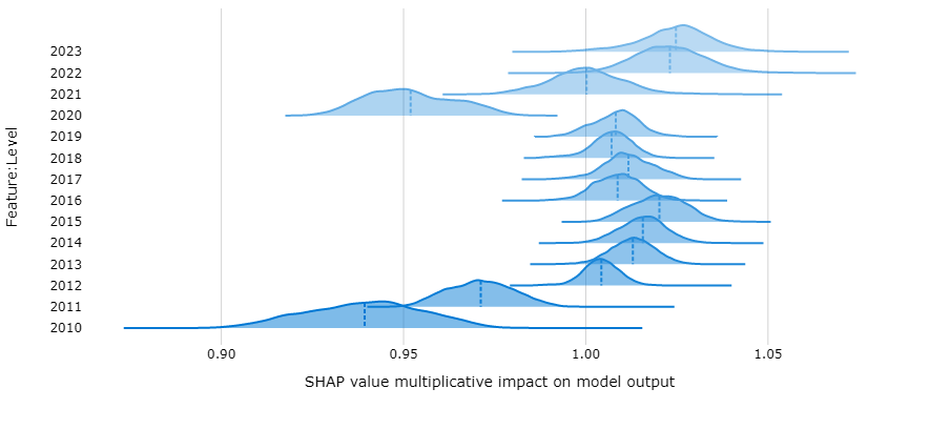
SHapley Additive exPlanations (SHAP) values can be useful for evaluating experience using predictive analytics as part of LTCI experience studies. Graphs of SHAP value distributions illustrate how a given variable contributes to model predictions across the experience dataset. The shapes of these distributions can provide insight into the pattern and magnitude of the variable’s impact on the model’s predictions. Multivariate SHAP value distributions can further illustrate interactions between multiple variables.
The figures below illustrate distributions of calendar year SHAP contributions to model predictions, expressed as multiplicative adjustments to the underlying benchmark expectation included in the experience analysis. Within each calendar year, the y-axis represents the density of observations receiving a given adjustment, and the x-axis represents the multiplicative adjustment to the benchmark expectation.
Experience analyses – claim incidence examples
Figures 1 and 2 show calendar year SHAP distribution graphs from recent LTCI experience studies and illustrate two patterns we have observed in claim incidence experience during the COVID-19 period. In Figure 1, calendar year 2020 appears to be an outlier relative to adjacent years; 2021 is slightly lower, while 2022 and 2023 are slightly elevated. In this scenario, a carrier may choose to exclude 2020 from the study window or retain 2020 but apply adjustments to normalize the experience.
Figure 1: Illustrative calendar-year SHAP graph from incidence study (example A)
In Figure 2, calendar years 2020 and 2021 are more consistent with pre-pandemic years, followed by an uptick in 2022, and a slight reversion in 2023. Although this may support including COVID-era experience, actuaries should analyze experience across additional variables and sites of care to evaluate whether COVID-era experience should be included in the study window.
Figure 2: Illustrative calendar-year SHAP graph from incidence study (example B)
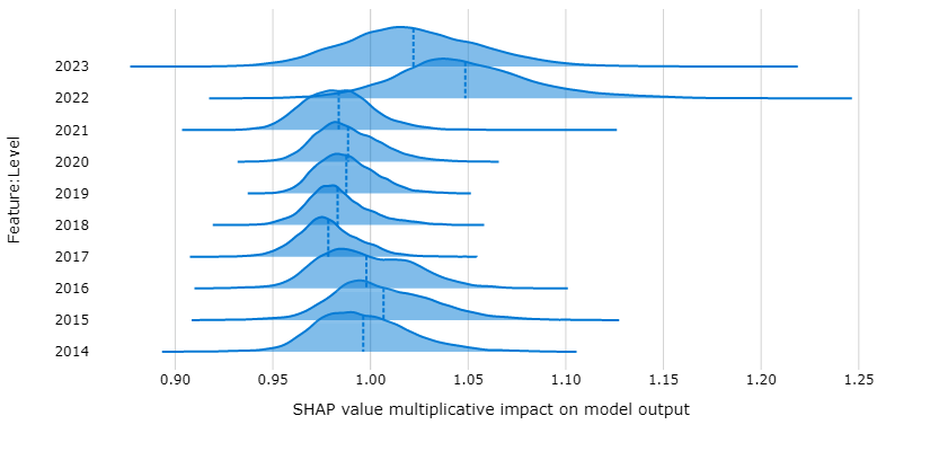
Figure 3 summarizes actual and expected distributions of site of care for a sample block of LTCI claims across calendar years, with the expected distribution based on the Milliman 2023 Long-Term Care Guidelines,4 without any adjustments to reflect pandemic shock. This illustrates the shift in site of care that we have observed during the COVID pandemic across multiple blocks within the LTCI industry, even in blocks where aggregate incidence patterns by calendar year do not exhibit outliers. In this example, 2020 exhibits a material shift away from assisted living and skilled nursing towards home health. The shift away from skilled nursing and towards home health has persisted after 2020.
Figure 3: Illustrative actual and expected distribution of incidence by site of care
| Calendar year | Actual distribution | Expected distribution | ||||
|---|---|---|---|---|---|---|
| Assisted living | Home health | Skilled nursing | Assisted living | Home health | Skilled nursing | |
| 2018 | 29% | 43% | 28% | 28% | 48% | 24% |
| 2019 | 33% | 43% | 24% | 28% | 48% | 24% |
| 2020 | 26% | 53% | 21% | 27% | 49% | 24% |
| 2021 | 31% | 47% | 22% | 27% | 50% | 23% |
| 2022 | 30% | 49% | 21% | 27% | 50% | 23% |
| 2023 | 31% | 49% | 20% | 26% | 51% | 23% |
Beyond incidence, we have observed pandemic-era variability in active mortality, disabled mortality, and claim recovery rates. Actuaries should consider how including or excluding COVID-era experience influences their best-estimate assumptions for future projected experience.
Survey of long-term care insurers on COVID-19 experience studies
We surveyed 16 LTCI carriers and reinsurers in Summer 2026 to understand how companies are treating COVID-19 experience in their experience studies. For each assumption, we asked how companies handled experience for each calendar year from 2020 through 2023. Below are some high-level takeaways on the overall survey results. Figure 4 provides additional detail on the treatment patterns observed across each assumption.
- Overall results
- Most companies evaluate COVID-19 impacts separately for each assumption when determining an approach
- Most companies either excluded COVID-19 experience or included it without adjustment; relatively few companies adjusted COVID-19 experience and then included it
- Most companies expect to treat COVID-era data consistently in their next experience study relative to their most recent study
Figure 4: Assumption observations from survey on COVID-19 experience
| Assumption | Observation |
|---|---|
| Active life mortality | Excluding calendar years 2020 through 2022 is common. No companies excluded 2023 experience. |
| Voluntary lapse | A majority of companies included experience throughout the COVID-19 period. |
| Claim incidence | Excluding calendar years 2020 and 2021 is common. No companies excluded 2023 experience. |
| Disabled life mortality | Most companies exclude 2020 experience. Fewer companies exclude experience from 2021 and 2022, and only one company excluded 2023. |
| Recovery | Most companies exclude 2020 experience. Relatively few companies excluded calendar years 2021 and 2022, and only one company reported excluding 2023 experience. |
| Utilization | Most companies include experience from 2020 through 2023. |
Additional considerations for actuaries when deciding how to treat COVID-19 experience
As seen above, deciding how to handle COVID-19 experience is not a one-size-fits-all exercise. Beyond statistical fit, actuaries need to weigh practical factors such as timing of a potential “new normal,” changing care patterns, and assumption interrelationships. Below are some topics that we believe actuaries should consider going forward:
- When does the “new normal” start? Has experience stabilized, and are there long-term effects from COVID? Actuaries will need to balance the credibility of new experience against the possibility that it reflects a “new normal.” For example, the pandemic contributed to high LTCI cost of care inflation. We have observed that many LTCI carriers use a shorter and more recent experience period when developing utilization assumptions to better reflect the latest experience. If actuaries have less confidence around the newest calendar years but believe a “new normal” has emerged, they may consider additional sensitivity tests to assess the impact of potential assumption volatility on projections of future LTCI experience.
- The decision to include or exclude certain calendar years might vary for different blocks. For newer or smaller blocks, the benefit of increasing credibility by including COVID-era years may outweigh the downside of increased volatility. Actuaries should consider the trade-offs of including or excluding COVID-era experience.
- The shift in the mix of care settings toward assisted living facilities and home health care accelerated during the pandemic. To the extent that the healthiest claimants from each site of care shifted toward a less intensive site (e.g., skilled nursing to assisted living, assisted living to home health), this may lead to each site of care becoming marginally unhealthier on average.
- How do incidence, active mortality, and claim termination interact with one another and across calendar years? For example, if claim incidence was abnormally low in 2020, were policyholders who went on claim in that year more or less healthy than the average claimant prior to the pandemic? Will they exhibit similar on-claim behavior to claims incurred prior to or after the pandemic?
Conclusion: Why long-term care actuaries should continue monitoring post-COVID experience
The impacts of the COVID-19 pandemic have created additional challenges for LTCI actuaries performing experience studies. One thing is clear: the answer is not one-size-fits-all. We have seen multiple strategies to handle COVID-19 experience, and approaches may vary by assumption, block, and carrier. Regardless of the strategy selected, ongoing monitoring of post-COVID experience is essential to identify any long-term impacts and to determine how the strategy should evolve.
1 Bergerson, M., Dalton, A., Duxbury, A., Eaton, R., & Stoltzfus, J. (October 2021). COVID-19 impact on long-term care insurance report: 2021 survey. SOA Report. Retrieved November 17, 2026, from https://www.soa.org/globalassets/assets/files/resources/research-report/2021/covid-19-impact-ltc.pdf.
2 The Impact of COVID-19 on Long-Term Care Insurance Experience—2025 [Issue brief]. (June 2025). American Academy of Actuaries. Retrieved November 17, 2026, from https://actuary.org/wp-content/uploads/2025/06/health-brief-Impact-COVID-LTCI-2025.pdf.
3 Bergerson, M., Gordon, M., Hebig, J., & Long, J. (February 2021). Unpacking predictive analytics for the long-term care insurance industry: How new approaches to model visualization can support greater understanding of results. Milliman. Retrieved November 17, 2026, from https://media.milliman.com/v1/media/edge/images/millimaninc5660-milliman6442-prod27d5-0001/media/Milliman/PDFs/2026-Articles/9-30-26_Unpacking-Predictive-Analytics-Long-Term-Care-Insurance-Industry.pdf.
4 The Milliman Long-Term Care Guidelines are a set of comprehensive benchmark morbidity assumptions that can be used for a variety of purposes. See https://www.milliman.com/en/health/long-term-care.