Recent policy changes to 1115 waiver budget neutrality
What are the new rules and how will they affect state Medicaid programs?
The enactment of H.R. 1 and subsequent guidance from the Centers for Medicare and Medicaid Services (CMS) fundamentally reshape the framework governing budget neutrality for Section 1115 Medicaid demonstrations.1,2 The main takeaway is that states seeking new demonstrations, amendments, or renewals will face heightened evidentiary standards and increased scrutiny of the fiscal impacts associated with activities authorized solely under Section 1115.
Three policy changes are particularly significant for states with 1115 waivers.
- Demonstrations will require certification by the CMS Chief Actuary that they are not expected to increase federal Medicaid expenditures
- CMS will no longer recognize many forms of hypothetical spending and expenditure authorities that have historically supported budget neutrality calculations, narrowing the scope of allowable financing assumptions
- Limitations on the carryforward of demonstration savings reduce states' ability to leverage accumulated budget neutrality room across renewal periods
Together, these changes create a fundamentally different operating environment for states and raise important questions about the future of existing waiver authorities, including health-related social needs (HRSN) services, coverage expansions, and other demonstration initiatives.
This white paper distills the policy changes to provide state Medicaid agency staff and leadership with practical implications. It provides a roadmap that states can customize to their existing or planned waivers to create a data-informed strategy to either preserve demonstration authorities or shift course before the new requirements take effect January 1, 2027.
Real-world implications of actuarial certification in demonstration waivers
Our interpretation of what the new Medicaid rules mean in practice
Under the new guidance, CMS actuarial certification will materially change when and how states must address budget neutrality in Section 1115 demonstration design. Rather than relying on a preliminary assessment followed by retrospective testing against a “without waiver” expenditure limit, states will need to demonstrate before approval that the proposed demonstration is not expected to increase federal Medicaid expenditures. For each Section 1115-only activity, CMS expects an actuarial, economic, statistical, or comparably rigorous analysis that clearly documents the underlying data, assumptions, methodology, and projected financial effects. The practical implication is not that states can no longer use estimates. Indeed, CMS acknowledges that prospective analyses may rely on modeling, simulation, estimation, or experience with comparable programs. Rather, unsupported “best guesses” or broadly stated hypotheses are unlikely to provide a sufficient basis for certification.
This underscores the importance of early and sustained collaboration among program, policy, operational, data, evaluation, and actuarial teams. Gone are the days when a demonstration’s policy design can be substantially completed before an actuary or finance professional is asked to construct the budget neutrality analysis shortly before submission. Under the new requirements, each Section 1115-only activity will need a defensible explanation of how it is expected to increase or decrease Medicaid expenditures, including effects on services and populations outside the activity itself and all associated administrative costs. Any claimed savings will need to be demonstrably attributable to the specific intervention, rather than to broader Medicaid trends or operational improvements that cannot be isolated from the demonstration. It is possible that CMS may also request multiple rounds of additional information, reclassify activities, or require revised analyses when demonstration terms change during negotiations, reinforcing the need for a well-documented analytical record from the outset and an integrated team that is ready to engage at all times.
In practice, states can expect a level of inquiry comparable to what they already encounter in Medicaid managed-care rate development and CMS rate review. Before the financial analysis can be credible, the state may need to make and document detailed decisions about:
- Covered populations, eligibility rules, service definitions, scope, and limitations
- Anticipated enrollment, participation, and service take-up
- Provider qualifications, network capacity, and implementation timing
- Payment methodologies and provider payment rates
- Expected utilization and unit costs for the new activity, as well as resulting changes in other Medicaid services
- Administrative costs and the state and federal shares of projected expenditures
- Data sources, trend assumptions, program experience, and evidence supporting each expected cost or offset
CMS anticipates that states will fully identify eligibility and service coverage criteria, payment methodologies, and payment rates before approval, with financial impacts generally presented by activity and, where applicable, on a per-member-per-month (PMPM) basis with corresponding enrollment estimates. States can likely expect budget neutrality negotiations to resemble the detailed questions posed during managed care rate review: What experience supports the assumption? How was the adjustment developed? Is the affected population represented in the data? What is the expected utilization response? Can the result be reproduced and defended?
The strongest starting point will often be an intervention that has already been implemented and evaluated, particularly where the evaluation uses robust methods and measures financial or utilization outcomes relevant to the proposed demonstration. For renewals, CMS expects historical analysis based on actual demonstration experience and a prospective analysis for the upcoming period. For new activities, experience from comparable Medicaid or other healthcare programs may inform projections, but evidence closely aligned with the proposed population, benefit, delivery model, and implementation conditions will generally provide a more credible foundation than loosely connected academic literature or an intervention that remains primarily theoretical. States can therefore treat implementation and evaluation planning as inputs to certification, not post-approval deliverables. CMS also intends to monitor expenditures and outcomes against state projections, require corrective action for substantial deviations, and consider whether evaluation findings demonstrate sustained progress toward the demonstration’s policy goals when reviewing renewals.
Actions to take before renewal time
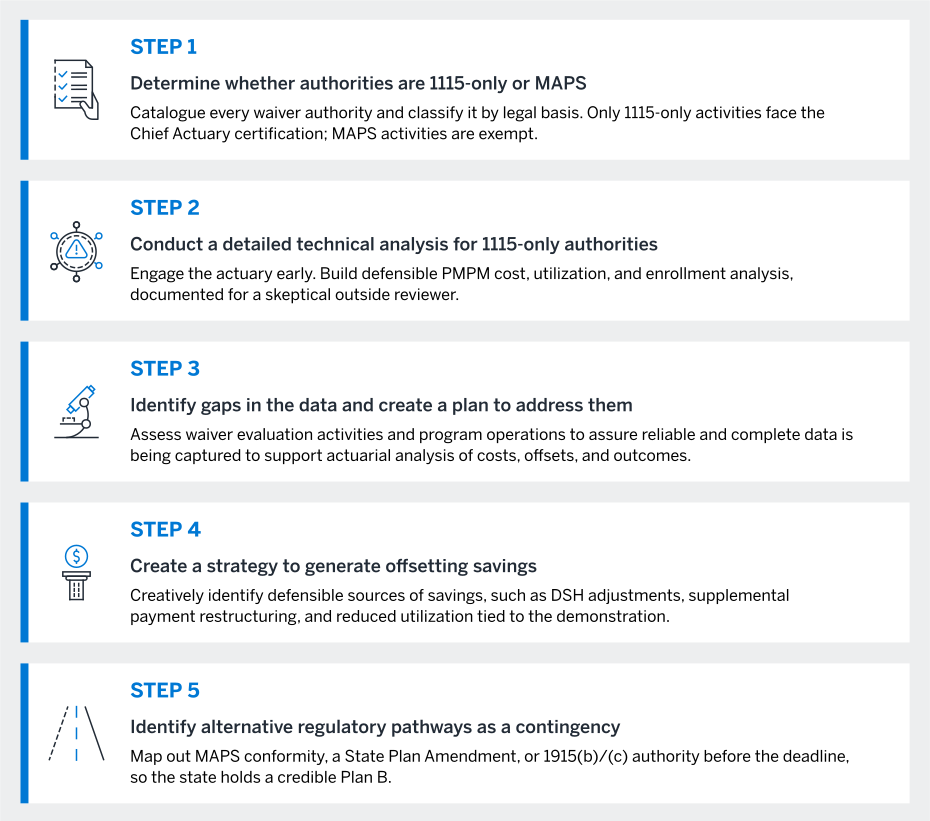
What can state Medicaid agencies do now to prepare?
With CMS placing renewed emphasis on rigorous budget neutrality certifications, states with active or upcoming Section 1115 demonstrations can take proactive steps now to prepare before their next renewal window opens. Although every state Medicaid program and demonstration waiver is unique, these high-level actions can be customized to conform to a state’s distinct context and evolving policy goals. Based on our experience working with state partners on 1115 waivers and capitation rate-setting, we expect the new certification requirements to substantially raise the analytical bar for demonstrating budget neutrality, which takes time to do accurately and well. States that start early will be far better positioned than those that begin once a renewal deadline is upon them.
1. Determine whether authorities are 1115-only or MAPS
The starting point is to catalogue each of the existing waiver authorities, which may range from eligibility and enrollment changes to benefit expansions and delivery system reforms, and classify each one according to its underlying legal authority. Some authorities operate solely under Section 1115 demonstration authority, whereas others may be authorized under a State Plan Amendment (SPA), a 1915 waiver, or other Title XIX authority. For each Section 1115 demonstration authority, states can then determine whether the waiver activities are 1115-only or Medicaid Authorizable Populations and Services (MAPS).
This distinction is critical because the Chief Actuary certification requirement under State Medicaid Director Letter #26-003,3 and the associated rigor required to demonstrate budget neutrality, place particular analytical focus on activities that require Section 1115 authority. Conversely, MAPS activities may have a more straightforward path because, to the extent they could otherwise be covered under existing Medicaid authorities outside of the demonstration, they do not rely exclusively on Section 1115 authority. This allows CMS to treat MAPS activities more similarly to existing “hypothetical expenditures” and recognize little or no net impact on the demonstration’s overall budget neutrality position. Accordingly, MAPS activities may raise fewer concerns within the actuarial certification framework and may also present alternative regulatory pathways outside of the demonstration.
An authority that is 1115-only has no current fallback if the actuarial case falls short; an authority that could plausibly move to MAPS or another pathway has options. States should not assume this classification is static or obvious, as programs are often layered or amended over time, and what began as a narrow 1115 demonstration may have accumulated features that could now be supported under a different authority. A careful policy and legal review can produce a clear authority-by-authority map before any actuarial work begins, since it determines which programs need to go through the higher-scrutiny budget neutrality process at all.
2. Conduct a detailed technical analysis for 1115-only authorities
Once a state has confirmed which authorities are truly 1115-only, that state should engage its actuary early to build a detailed, defensible technical analysis of the associated costs and savings. Because the Chief Actuary's office is now certifying budget neutrality directly, the analysis needs to meet a materially higher standard of rigor than may have been sufficient in past renewal cycles.
In practice, this means the actuarial team gathers and analyzes historical program data, including PMPM costs, utilization trends, and enrollment data. If any gaps or limitations in program data are found, it will be important to identify and address them as soon as possible. Documentation can be built assuming a skeptical outside reviewer will scrutinize every assumption. Data sources, methodology choices, and the rationale for each adjustment should be well-documented and supported. It will be important for states to budget realistic time for this work: A defensible technical analysis of this depth typically requires time for the actuarial and data analysis, so starting well ahead of the submission deadline is essential.
3. Identify gaps in the data and create a plan to address them, including updating your evaluation approach to support renewal
Actuarial projections are only as credible as the data and methods that stand behind them. For ongoing waivers, states can assess program operations and independent evaluations to make sure the data needed to evaluate cost impacts and potential offsets is being reliably generated.
States should not assume that the necessary data for future actuarial analyses will emerge organically once a program launches. Operational processes should be intentionally designed to support consistent and complete data collection from the outset, including enrollment and eligibility tracking, service utilization, expenditures, provider participation, beneficiary characteristics, and key outcome measures. Early investments in data infrastructure and governance can help avoid significant analytical limitations later when evidence is needed to support budget-neutrality assumptions. To the extent that initiatives are already underway, the sooner the state can identify any course corrections needed on data collection, the better equipped it will be at renewal time.
States can treat their evaluators as a critical partner in this process rather than a separate, parallel compliance exercise. States can also ensure evaluators and actuaries are working closely with each other throughout the process: Evaluation timelines, data definitions, and outcome measures can be aligned with what the actuarial analysis needs to demonstrate, rather than being developed in isolation and reconciled only after the fact. A well-coordinated evaluator–actuary relationship can turn evaluation findings into some of the strongest evidence a state has for defending its budget neutrality case.
4. Create a strategy to generate offsetting savings
States can also broaden their search for legitimate, defensible sources of savings that can help balance the budget neutrality equation, rather than assuming all offsetting savings must come from within the demonstrations or a single demonstration activity’s core benefit design. Disproportionate Share Hospital (DSH) payment adjustments are one example, as some states have successfully incorporated reductions or reallocations in DSH spending, tied to reduced uncompensated care resulting from coverage expansions, into their overall budget neutrality analysis. Other potential offsets worth exploring include supplemental payment restructuring and reductions in avoidable utilization (e.g., emergency department use or avoidable hospitalizations) that can be credibly tied back to the demonstration's interventions.
The key is creativity paired with defensibility: Any offset a state proposes needs a clear causal or programmatic link to the demonstration, supported by data, so it can withstand the same level of actuarial scrutiny as the cost side of the ledger. It may be beneficial to start this brainstorming process early and involve program staff who understand the operational details of DSH, supplemental payments, and delivery system reforms, since these offsets are often easy to overlook if the analysis is left solely to staff working from claims data alone.
5. Identify alternative regulatory pathways as a contingency
The actuarial analysis should not be construed as an all-or-nothing bet on the existing 1115 authority. For programs where early modeling suggests the budget neutrality case is going to be difficult or impossible to make persuasively, states can proactively map out alternative regulatory pathways, such as shifting the policy to conform to the new MAPS definition, pursuing a SPA, using 1915(b) or 1915(c) waiver authority, or restructuring the program to fit within existing state plan flexibilities, well before the renewal deadline arrives. For example, if a state does not expect to be able to produce stronger evidence of cost offsets associated with HRSN services, one approach to preserve some access is to transition eligible services to a 1915(c) waiver and limit coverage to individuals at risk of institutionalization.
Building this contingency plan early serves multiple purposes: It gives the state a credible fallback if CMS or the Chief Actuary pushes back on the budget neutrality certification, and it reduces the operational risk of a program lapsing or being disrupted if the 1115 renewal stalls. States can treat this pathway analysis as a standing part of their waiver management process, reviewed periodically alongside the actuarial and evaluation work, rather than a one-time exercise triggered only when a renewal looks questionable.
Taken together, these five actions respond to a broader shift in how states can approach 1115 waiver management under State Medicaid Director Letter #26-003: Budget neutrality certification is no longer a periodic compliance milestone but an ongoing analytical discipline, requiring sustained collaboration between state Medicaid staff, actuaries, policy experts, evaluators, and CMS well in advance of any renewal deadline.
1 See House Resolution H.R.1 An act to provide for reconciliation pursuant to title II of H. Con. Res. 14, Section 71118. 119th Congress (2025–2026) Retrieved October 13, 2026, from https://www.congress.gov/bill/119th-congress/house-bill/1.
2 Brillman, D. (2026, June 11). Budget neutrality and certification by the Chief Actuary of CMS for Section 1115 Medicaid demonstration projects [State Medicaid Director Letter #26-003]. Centers for Medicare and Medicaid Services. Retrieved October 13, 2026, from https://www.medicaid.gov/federal-policy-guidance/downloads/smd26003.pdf.
3 Brillman, D. (2026, June 11). Budget neutrality and certification by the Chief Actuary of CMS for Section 1115 Medicaid demonstration projects [State Medicaid Director Letter #26-003]. Centers for Medicare and Medicaid Services. Retrieved October 13, 2026, from https://www.medicaid.gov/federal-policy-guidance/downloads/smd26003.pdf..