There is a significant difference in how capital and surplus are managed between for-profit and nonprofit or not-for-profit companies. This difference leads to very different metrics, such as return on equity and risk-based capital (RBC) ratios. Generally, for-profit health insurers operate in their local jurisdiction with a lower capital and surplus level, reporting lower RBC ratios, while their increased leverage leads to higher returns on equity. This management approach usually entails larger and more frequent contributions of capital to the insurer by its ultimate owners, as well as more frequent dividends being paid out by the insurer. In contrast, nonprofit or not-for-profit insurers have less access to outside capital and therefore must effectively manage business requirements and risk by holding more capital and surplus on their own balance sheet.
Each U.S. health insurance company is domiciled within and regulated by a specific state, even if they are part of a larger parent company at the regional or national level. These state-based statutory entities must hold capital and surplus on their own balance sheets at sufficient levels to secure any in-force insurance obligations, meet the RBC requirements of their insurance commissioner, and provide working capital to support product expansions and growth. Capital and surplus will change each year through profits and losses on insurance products and investments but will also change due to contributions of capital into the company, dividends paid out to owners, and other reasons (Figure 1).
Figure 1: Key drivers of the annual change in capital and surplus, 2022-2024 average
| TOP 31 PARENT COMPANIES | ||||
|---|---|---|---|---|
| CAPITAL AND SURPLUS | NATIONWIDE AVERAGE (2022–2024) |
AVERAGE | FOR-PROFIT | NONPROFIT AND NOT-FOR-PROFIT |
| RBC ratio (1) | 608% | 603% | 499% | 774% |
| Net income (Percent of revenue) | 2.0% | 2.4% | 3.2% | 0.7% |
| Annual growth in capital and surplus (percent of prior year) |
3.5% | 4.3% | 7.4% | 1.3% |
| Change due to net income | 9.4% | 12.0% | 21.7% | 2.3% |
| Contributions from surplus notes, paid-in capital, and surplus |
3.9% | 3.6% | 4.9% | 2.4% |
| Withdrawals using stockholder dividends and aggregate write-ins (2) |
-9.0% | -10.6% | -18.4% | -2.9% |
| Change in unrealized capital gains and losses | -0.4% | -0.2% | 0.1% | -0.5% |
| Other asset valuation changes (3) | -0.9% | -0.8% | -1.0% | -0.6% |
| Other changes in capital and surplus | 0.5% | 0.4% | 0.0% | 0.7% |
Source: Milliman analysis of health annual statements (Orange Blanks) for statutory entities in each state, as available publicly through June 2025. Entities may be part of a larger holding company system with an ultimate parent company. The top 31 parent companies own numerous state-based entities that compromise over 80% of annual revenue and capital in the health insurance industry.
(1) The ratio of capital and surplus (e.g., net equity) to the minimum RBC requirement, referred to as the authorized control level.
(2) Most nonprofit and not-for-profit health plans record ordinary distributions as aggregate write-ins, whereas for-profit health plans record stockholder dividends in a designated line.
(3) Other asset valuation changes include changes in non-admitted assets, changes in deferred income tax, and others.
Health insurers hold capital and surplus at an RBC ratio of around 600% or more on average. However, insurers that are part of a for-profit parent company tend to hold less capital and surplus, at a ratio closer to 500%, compared to ratios closer to 700%-800% for nonprofits and not-for-profits. This difference does not imply that for-profit companies are at greater risk; instead, this is a result of how they manage their capital and surplus. For-profit corporations tend to consolidate more assets at the parent company level and then manage risk using an aggregate RBC calculation across all of their state-based subsidiaries.
For-profit companies tend to hold less capital and surplus at the state-based level because their profit goal requires a more leveraged deployment of capital and surplus. As a result, while net income as a percentage of revenue is already higher among for-profit companies, it is even greater when measured as a percentage of beginning surplus due to higher leverage (Figure 2).
Figure 2: Net income by year for top 31 parent companies, as a percentage of revenue and as a percentage of beginning-of-year capital and surplus
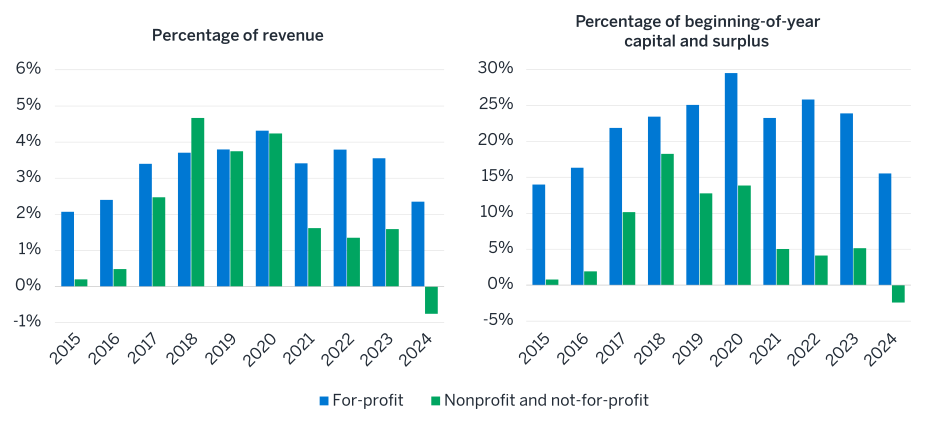
For-profit companies tend to have higher margins. Holding less capital and surplus further leverages their return on equity.
Over the last three years, net income as a percentage of revenue averaged +2.0% (+3.2% among larger for-profit parent companies and +0.7% among larger nonprofit and not-for-profit parent companies). Over the same period, return on equity, measured as net income as a percentage of beginning-of-year capital and surplus, averaged +9.4% (+21.7% among larger for-profit parent companies and +2.3% among larger nonprofit and not-for-profit parent companies). In addition to earning higher profit margins, for-profit companies tend to hold less capital and surplus, and this additional leverage leads to an even higher return on equity than their nonprofit and not-for-profit counterparts.
To complement the higher rate of surplus growth from income, for-profit companies shift a greater share of surplus to their ultimate owners in the form of stockholder dividends, compared to distributions paid out by nonprofit and not-for-profit companies (Figure 3). For-profit companies also tend to receive more frequent contributions of capital from outside sources, which is consistent with either more centralized management of assets at the parent company level or more frequent use of capital markets.
Figure 3: Comparison of capital flows in and out of companies by type
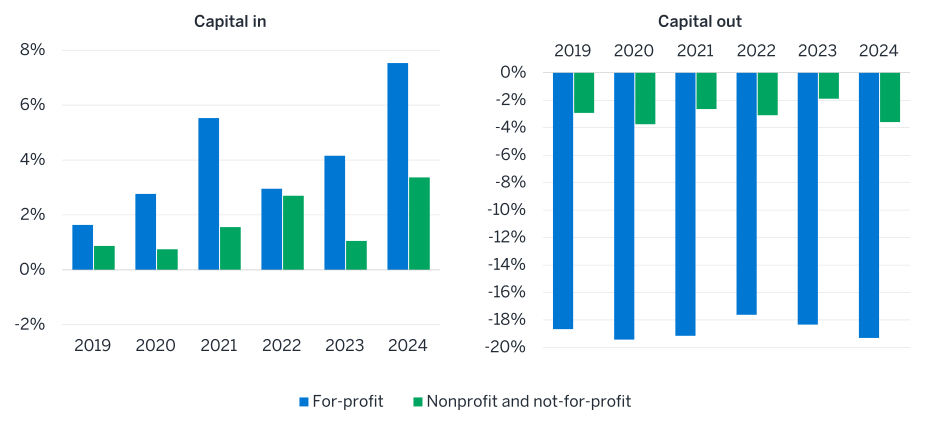
For-profit parent companies tend to hold more assets outside of their state-based entities, contributing capital when needed.
It is more efficient for a for-profit parent company to receive and retain more of the overall capital and surplus generated by its subsidiaries so that in the future, the capital can be effectively deployed toward growth opportunities, used to pay stockholder dividends, or committed to shore up a particularly less resilient subsidiary that has experienced losses. By contrast, nonprofit and not-for-profit companies tend to keep more capital and surplus at the state-based entity level, leading to much higher RBC ratios. Most nonprofit and not-for-profit companies are restricted by their insurance commissioner from making distributions to their parent company, which hampers the flow of capital off their balance sheets. As a result of these different approaches to holding capital and surplus among companies in a particular state, the for-profit companies may have more of their safety net residing in external, out-of-state parent companies, whereas the nonprofit and not-for-profit companies may hold more of their safety net on their own balance sheet.
Because they can more readily access outside capital and choose to hold more surplus at the parent company level, local for-profit insurers are more likely to hold less and then receive new capital and surplus when it is really needed. When the state-based entities are managed with a smaller balance sheet, they necessarily rely more on their parent company as a safety net when managing the ups and downs of the business cycle, and they also must receive new capital and surplus when launching a new product or expanding into a new services area.
Capital and surplus will also be affected by the value of financial assets held on the balance sheet. Changes in asset valuation are driven primarily by the unrealized capital gains and losses of financial assets. Due to the short-term nature of most health insurance contracts, insurer assets tend to be concentrated in cash, cash equivalents, and liquid bonds, though they may also have significant stock holdings, real estate, and other non-financial assets. Fluctuations in asset values can have a significant impact on capital and surplus, occasionally more so than gains and losses from the insurance contracts themselves.
Figure 4: Changes in asset valuation due to unrealized capital gains and losses, correlated with financial markets
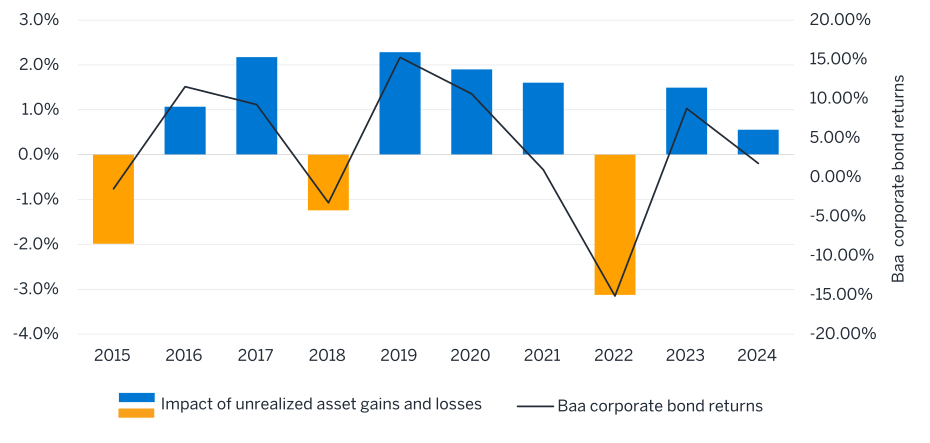
Changes in financial markets, especially the bond market, will have a significant impact on the capital and surplus of a health insurer because they tend to hold significant amounts of fixed income assets. Shifts in the market value of these securities show up as a change in capital and surplus. The annual impact of financial asset valuation changes on company capital and surplus levels is well correlated with bond market returns.1 For example, the recent inflation shock of 2022 caused health plans to write down significant assets while it depressed stock and bond prices.2 For the average plan, this caused a loss that was around 3% of annual revenue, equating to about a -20% nominal decrease in the RBC ratio. These swings are significantly dampened for for-profit companies since they hold fewer financial assets (e.g., -5% nominal RBC ratio decrease for the average for-profit company versus -33% nominal decrease for the average nonprofit and not-for-profit company).
Data and methodology
This analysis relies on NAIC Health Annual Statement values related to statutory capital and surplus for U.S. health insurers from the years 2014–2024 in all U.S. states except for California. California health insurers file different annual statements, as required by the California Department of Managed Health Care, and they do not submit the standard NAIC annual statements that are relied upon in this analysis. These historical financials for all other states were sourced from the S&P Global Market Intelligence platform, which captures information reported by each entity. The analysis is consistent with NAIC reporting for the same companies.3
An adjustment was applied as needed to align each entity’s restated beginning-of-year capital and surplus with the final amount reported for the prior year. This true-up eliminates discontinuities arising from post-filing restatements and ensures that all subsequent movements in capital and surplus reflect transactions occurring within the current reporting period. Entity to parent group relationships were determined as of August 2025, and they were backdated throughout the entire 2014–2024 study period.
Limitations and considerations
In performing our analysis, we relied on data and other information provided to us by other entities, including publicly available data sources. We have not audited or verified this data and other information. If the underlying data or information is inaccurate or incomplete, the results of our analysis may likewise be inaccurate or incomplete.
This analysis is based on historical data and may not reflect current and future financial relationships. Emerging experience should be monitored, and updates made as appropriate. The report presents averages, and significant variation may exist within the data underlying these averages.
Models used in the preparation of our analysis were applied consistently with their intended use. We have reviewed the models, including their inputs, calculations, and outputs for consistency, reasonableness, and appropriateness to the intended purpose and in compliance with generally accepted actuarial practice and relevant actuarial standards of practice (ASOP). The models, including all input, calculations, and output may not be appropriate for any other purpose. Where we relied on models developed by others, we have made a reasonable effort to understand the intended purpose, general operation, dependencies, and sensitivities of those models. We relied on input, review, and validation by other experts in the development of our models.
The authors are members of the American Academy of Actuaries and meet the qualification standards for performing the analyses presented in this report.
1 NYU Stern School of Business. (January 2025). Historical returns on stocks, bonds and bills: 1928-2024. Retrieved October 21, 2025, from https://pages.stern.nyu.edu/~adamodar/New_Home_Page/datafile/histretSP.html.
2 Federal Reserve Bank of St. Louis. (October 24, 2025). 1-year expected inflation. Retrieved December 5, 2025, from https://fred.stlouisfed.org/series/EXPINF1YR.
3 National Association of Insurance Commissioners. (2021). Aggregated health risk-based capital data: 2025 data as of 6/3/2025. NAIC Financial Data Repository. Retrieved September 1, 2025, from https://content.naic.org/sites/default/files/inline-files/Health_RBC_Statistics_2024.pdf. The report indicates an average RBC ratio of 605% over the past three years, similar to the 608% value from Milliman’s independent analysis, shown in Figure 1.