Answering the question of “What is this drug’s price?” can be more complicated than it sounds. Depending on the perspective, a drug’s “price” can mean its list price, its reimbursed amount, or its cost to a patient. A clear understanding of the concepts underlying drug pricing terms and acronyms is critical for everything from effective communication to crucial decision-making.
This paper outlines commonly used pricing terms in the U.S. pharmaceutical market: Wholesale Acquisition Cost (WAC), average sales price (ASP), net price, usual and customary (U&C) price, Average Wholesale Price (AWP), average manufacturer price (AMP), National Average Drug Acquisition Cost (NADAC), and Maximum Fair Price (MFP). This paper defines each pricing term, explains its calculation, and outlines its role in the healthcare industry, providing stakeholders with the understanding and language they need to avoid unintended consequences and make informed, strategic decisions. We have also included a visual representation of the relationships between these pricing terms for a branded, generic, and physician-administered drug.
1. WAC (Wholesale Acquisition Cost)
Definition: Also known as the list price, WAC is the manufacturer's price for a drug to wholesalers or direct purchasers, before any discounts or rebates.
Use: WAC provides a common starting point for branded drugs in health insurer contracting and budgeting models. Because this price does not reflect any downstream discounts or rebates, it is not typically the actual cost paid by health insurers and patients.
2. AWP (Average Wholesale Price)
Definition: AWP is a benchmark price that was originally intended to approximate the average price that wholesalers charged pharmacies. However, today AWP is typically derived as WAC +20% for brand drugs or the reference brand’s WAC minus a discount for generic drugs.1
Use: AWP serves as a common reference point for reimbursement formulas and drug spend projections. Although still used in many markets, some have shifted away from AWP over concerns that it may be artificially inflated.2
3. ASP (average sales price)
Definition: ASP is a volume-weighted average of a drug’s sales price from a manufacturer to all purchasers, including government programs such as Medicare and Medicaid. It is net of price concessions—such as volume discounts, chargebacks, and prompt-pay discounts—and other rebates, including Medicaid Drug Rebate Program (MDRP) rebates.
Use: ASP is used by the Centers for Medicare and Medicaid Services (CMS) to determine reimbursement rates for Medicare Part B physician-administered drugs. This reimbursement is calculated as ASP +6% for most drugs, or the brand’s reference ASP +8% for certain biosimilar drugs.3 Both rates are subject to a 2% decrease in reimbursement due to sequestration.4 Many commercial insurers also use ASP as a base for their physician-administered drug reimbursement with varying markups.
4. Net price
Definition: Net price is the pharmaceutical manufacturer’s revenue after subtracting most discounts, rebates, chargebacks, and fees across all market segments and programs (e.g., commercial, Medicare, Medicaid, Veterans Affairs, 340B). Some discounts that are typically excluded from net price are the low-income subsidy (LIS), reinsurance, and the selected drug subsidy.
Use: Confidential to a drug manufacturer, the net price is used for gross-to-net (GTN) forecasting and is a key component of pharmaceutical manufacturers’ drug pricing strategy. Note that the GTN will vary based on market segment, and a drug’s net price is an average of the resulting mix.
5. U&C (usual and customary price)
Definition: U&C is the average price paid by consumers who have no pharmaceutical insurance coverage. This is also called the cash price. Pharmacies set this price for both brand and generic drugs.
Use: Pharmacy benefit manager contracts are often written so they pay the lower of the negotiated price or the U&C for all drugs. When a customer without insurance purchases a drug, they are charged the pharmacy’s U&C.
6. AMP (average manufacturer price)
Definition: AMP is the average price paid after discounts to drug manufacturers by wholesalers and retail pharmacies who have purchased directly from the drug manufacturer. For their drugs to be covered under Medicaid, drug manufacturers are required to report all their drugs’ AMP information quarterly to CMS.
Use: AMP is used to calculate the Medicaid rebates, known as the Unit Rebate Amount (URA), that drug manufacturers pay to states.5 It also helps determine the federal upper limit (FUL), which is the maximum reimbursement for certain generic drugs.6
7. NADAC (National Average Drug Acquisition Cost)
Definition: NADAC is an estimate of the average price that non-specialty retail community pharmacies pay to acquire brand and generic drugs. The average is based on surveys of the invoice prices paid by retail community pharmacies in the United States and is updated by CMS weekly. This is the invoice price before any off-invoice discounts, rebates, or other price concessions are applied.
Use: Because NADAC relies on actual pharmacy invoice prices, it provides a more accurate benchmark than AWP or WAC for state Medicaid programs to reference when determining their pharmacy reimbursement rates. Increasingly, commercial payers and PBMs are using NADAC as a reference to negotiate drug prices, rather than AWP.
8. MFP (Maximum Fair Price)
Definition: The MFP is the maximum per-unit price that a manufacturer may charge Medicare for drugs selected under the Medicare Drug Price Negotiation Program created by the Inflation Reduction Act. The MFP is bounded by 40%-75% of the drug’s nonfederal AMP, depending on what type of drug and how long it has been on the market.
Use: Beginning with prices effective in 2026, Medicare Part D (and later Part B) plans must reimburse at or below the MFP for each selected drug. CMS publishes the MFP annually for all selected drugs. Each year, CMS may select 20 additional drugs for negotiation, with the prices going into effect two years later.
The distinctions among WAC, AWP, ASP, net price, U&C, AMP, NADAC, and MFP reflect the many ways drug "price" can be interpreted. Below is a visual representation of the relationship among these pricing terms for a branded, generic, and physician-administered product. Understanding drug pricing terminology is more than just technical knowledge; it is essential to making well-informed decisions in the healthcare market. This paper serves as a starting point for understanding these terms and their uses. By becoming more familiar with these and other drug pricing concepts, stakeholders can approach contracting, forecasting, and compliance discussions with greater clarity.
Figure 1: Illustrative example of the relationship between drug prices for a branded, generic, and branded physician-administered product*
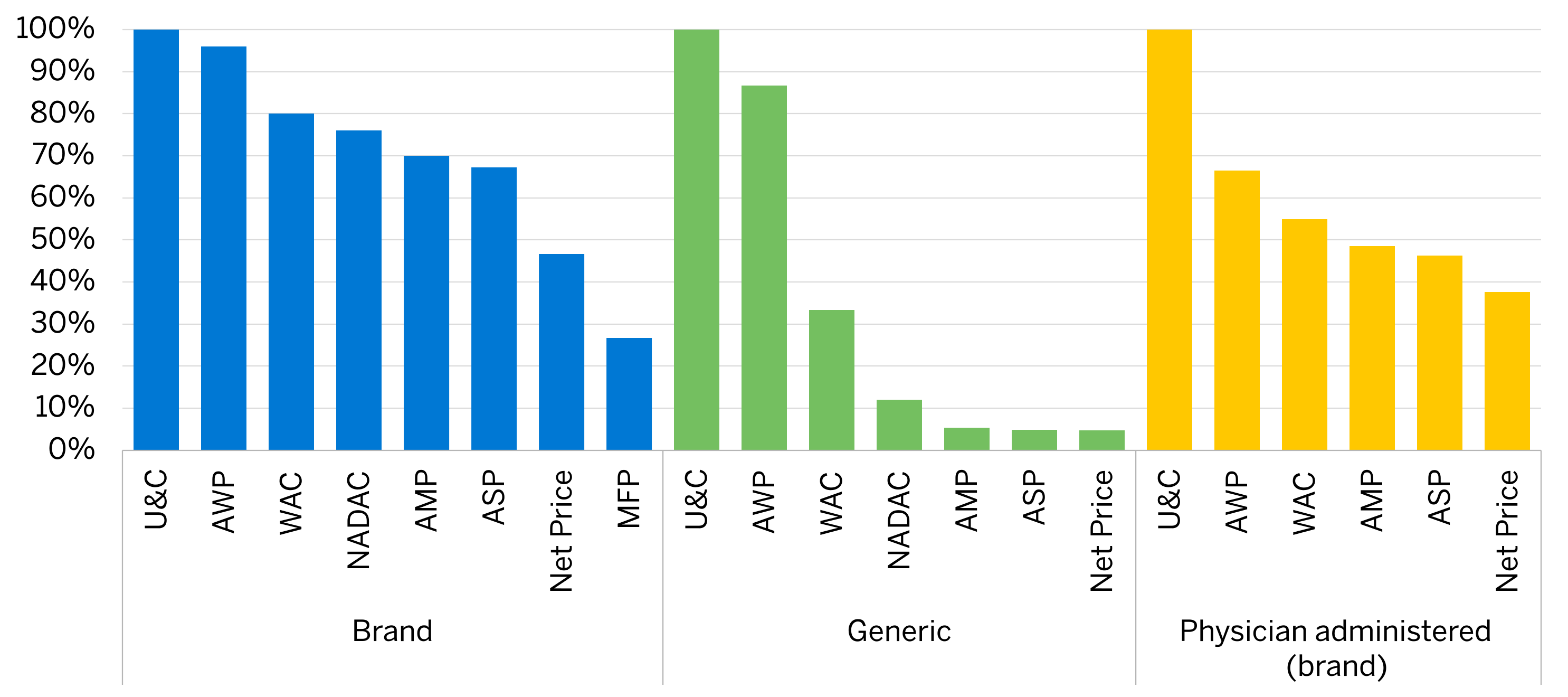
*Figure 1 serves as an example of how a drug’s prices may vary. Medispan Price Rx was used as a reference point where available; other prices were chosen based on their relationship to these reference points. Note that this is illustrative only, and any individual drug may vary their pricing strategy to produce different results. Some prices, like NADAC, are limited to products dispensed in a retail setting and may not exist for physician-administered products.
1 Reck, J., & Butler, J. (2022, April 25). State drug price transparency programs identify critical data on high cost drugs.” National Academy for State Health Policy. Retrieved March 3, 2026, from https://www.nashp.org/state-drug-price-transparency-programs-identify-critical-data-on-high-cost-drugs.
2 Centers for Medicare and Medicaid Services. (December 2024). Methodology for calculating the National Average Drug Acquisition Cost (NADAC) for Medicaid covered outpatient drugs. Retrieved March 3, 2026, from https://www.medicaid.gov/medicaid-chip-program-information/by-topics/prescription-drugs/ful-nadac-downloads/nadacmethodology.pdf.
3 Centers for Medicare and Medicaid Services. (n.d.). Frequently asked questions: Inflation Reduction Act, biosimilars temporary payment increase. Retrieved March 3, 2026, from https://www.cms.gov/files/document/biosimilar-faqs.pdf.
4 Weidner, S., Diaz, M., Schaedig, C., & Gordan, L. (2021, June 21). Observations regarding the average sales price reimbursement methodology. American Journal of Managed Care, 27(4). Retrieved March 3, 2026, from https://www.ajmc.com/view/observations-regarding-the-average-sales-price-reimbursement-methodology.
5 Centers for Medicare and Medicaid Services. (2026, February 3). Unit Rebate Amount information. Retrieved March 3, 2026, from https://www.medicaid.gov/medicaid/prescription-drugs/medicaid-drug-rebate-program/unit-rebate-amount-calculation.
6 Centers for Medicare and Medicaid Services. (2025, February 13). Federal Upper Limit. Retrieved March 3, 2026, from https://www.medicaid.gov/medicaid/prescription-drugs/federal-upper-limit.