A defined benefit pension plan is an employer-sponsored benefit that provides lifetime income for plan participants in retirement. The management of a pension plan consists of two equally important but opposite elements: 1) plan liabilities, which are the discounted present value of estimated benefit payments that the plan expects to pay out to participants in the future; and 2) plan assets, which are monies set aside to fund those payments. To accumulate a sufficient amount to pay for the plan liabilities, this money is invested over many years. How this money is broken out into different types of investments is the plan’s asset allocation. Asset allocation is a critical aspect of pension plan management, as it directly impacts the plan’s ability to meet its long-term obligations to retirees.
The “balance equation” for a defined benefit (DB) pension plan can be viewed like this:
Contributions + Investment Earnings = Benefit Payments + Expenses
The investment earnings in this equation are heavily influenced by the plan’s asset allocation.
When developing an asset allocation strategy, it is therefore important to consider the unique goals and circumstances of the pension plan. Although all plans aim to provide income and financial security for their retirees, the optimal investment approach will depend on several other factors:
1. How legal and regulatory requirements affect DB plan asset allocation
Pension plans must comply with a range of laws and regulations. For example, US qualified pension plans are required to make a minimum required contribution each year in accordance with minimum funding requirements of the Employee Retirement Income Security Act of 1974 (ERISA) and the Pension Protection Act of 2006 (PPA). Asset allocation strategies may be designed to generate sufficient returns to minimize or even eliminate these funding requirements, with allocations varying depending on the plan’s funded status.
In addition, some plans face restrictions on the types of investments they can hold. For example, certain public pension plans are prohibited from investing in fossil fuel-related assets. Another example is that multiemployer plans that receive Special Financial Assistance from the Pension Benefit Guaranty Corporation are required to invest at least 67% of their assets in investment-grade fixed income. Investment advisors must monitor holdings to ensure compliance with such requirements.
2. Pension plan asset allocation: The impact of plan demographics
Every plan has a unique demographic profile that will influence the plan asset allocation. A plan with younger participants may have a need for greater capital appreciation to fund future benefits, often leading to a more aggressive, equity-heavy strategy. Conversely, a plan made up of mostly older, retired participants will typically require greater income generation and capital preservation, making fixed income investments more appropriate.
3. Plan benefit structure shapes pension liabilities and investment strategy
The plan’s benefit formula also shapes its liabilities and, consequently, its investment strategy.
Plans offering lump sum options may experience large, unpredictable withdrawals, requiring higher liquidity. These plans might need to allocate more assets to highly liquid investments, such as cash or short-term bonds, at a potential cost to overall plan return.
Plans that pay a Cost of Living Adjustment (COLA) to participants will see benefits increasing every year with inflation. These plans may favor a larger proportion of equities for growth, or inflation-indexed bonds to help match increasing liabilities.
Some pension plans have a variable annuity benefit. In these plans, benefit levels fluctuate depending on plan returns above or below a set hurdle rate. When plan returns are above the hurdle rate, participant benefits will increase, and when plan returns are below the hurdle rate, participant benefits will decrease. An investment strategy targeting that hurdle rate—balancing growth and stability—can be effective.
4. DB asset allocation: The goals of the plan sponsor
The sponsor’s objectives also play a significant role in asset allocation decisions.
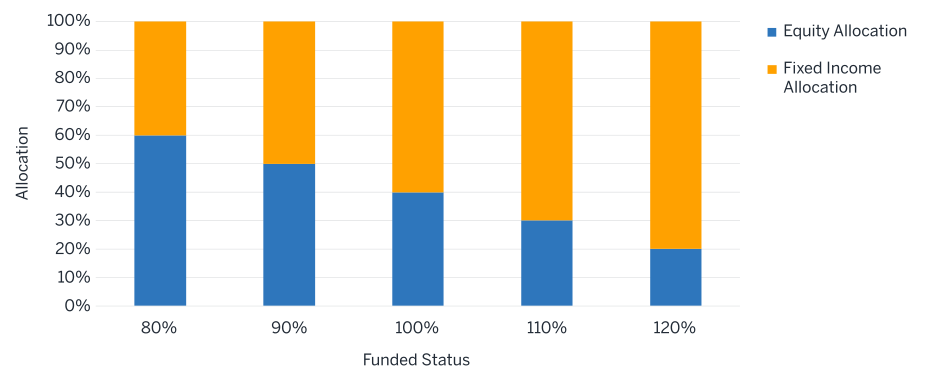
A plan sponsor may wish to improve the funded status of the plan. Sponsors seeking to enhance funded status can either increase contributions or allocate more assets to expected higher-returning investments. Some adopt a "glidepath" approach, gradually shifting from equities to fixed income as the plan becomes better funded.
Figure 1: Sample glidepath
Increasing participant benefits can help attract and retain employees, but these enhancements also raise plan liabilities. This may require a higher allocation to growth assets.
Finally, some plan sponsors seek to terminate their pension plans. When aiming to terminate a plan, sponsors must ensure the plan is fully funded to purchase annuities or pay lump sums. A liability-driven investment (LDI) strategy, which matches the interest rate sensitivity—known as the “duration”—of assets and liabilities, can help preserve funded status as interest rates change. Full LDI involves matching the duration of the plan’s liability to the duration of its assets so that plan funded status is protected against interest rate movements. Alternatively, partial LDI strategies blend fixed income and equities for plans to provide for some growth and some protection against interest rate risk.
Conclusion: Why each pension plan must customize its asset allocation strategy
There is no one-size-fits-all approach to pension plan asset allocation. Each plan must tailor its investment strategy to its legal obligations, participant demographics, benefit structure, and sponsor objectives. By carefully considering these factors and working with the plan’s investment advisors, plan sponsors can design an allocation strategy that best supports their long-term commitments to retirees.